Showing posts with label Astronomy. Show all posts

25 August 2017

THE INTERSECTION OF TWO HEAVENLY BODIES IS NOT RARE!


-->

We were so happily enthralled and overshadowed by the solar eclipse of August 21, 2017! What awe! What mystery! What fun! Some of us had made plans for months to travel to some spot within the seventy mile “path of totality.” Others of us took off work to watch with special glasses or homemade pinhole viewers. Those who experienced the total eclipse, when the world became dark for up to two minutes or so, were spectacularly moved. Others of us shared their thrill vicariously.

Wherever we were, it was wonderful for us to pause, and to let it be. Recognizing, and imagining, the paths of two huge celestial bodies – heavenly bodies! – crossing each other was a truly awe-inspiring event. I would say that those several hours on August 21, of waiting and watching, touched people with transcendence, a sense of majesty and power that was so much bigger than us. Moreover, we shared those transcendent moments with other people: some of them friends, but others in campgrounds and parks, and some of them strangers we happened to park beside along the road. We shared both transcendence and intimacy.

For some of us, the more we studied the event, the more profound particular details became. We were aware that the moon’s shadow was racing across the continent at between one thousand and three thousand miles per hour. We were aware of slight angles in the earth’s and moon’s orbits that make an eclipse possible. We were aware that the precise size of the moon, at this particular time in its gradual withdrawal from the earth, is what makes a total eclipse possible – and not an annular eclipse (which does not completely cover the disc of sun).

Finally, some of us became aware of something else. Solar eclipses are not exactly rare. They are certainly rare if you stay in one place on the earth. However, they occur somewhere on earth about once every eighteen months – about 2 every 3 years. Indeed, many people claim to be “eclipse chasers,” making plans even now to be at the next solar eclipse on July 2, 2019 (though most of it will occur over water, in the South Pacific Ocean). I read where Joseph Pasachoff, astronomer from Williams College, has experience 65 solar eclipses.

I reckon, then, that if we include space and time outside earth, then celestial bodies –let’s call them heavenly bodies!—are intersecting their paths somewhere, almost all the time. Stars are crossing in front of other stars. Moons are coming between suns and planets. (These events are called “occultations,” which means “hidings”).

In the tremendous universe of God, then, there is always an intersection happening somewhere. What if we, we ourselves, are also such heavenly bodies? Sometimes, we are depending upon one light source, and another body moves between us and the source. Sometimes that movement occurs with amazing speed. We can see the shadow moving quickly along the floor, and it overtakes us. Sometimes the shadow is not a negative phenomenon at all, and the darkness can be helpful to us. Darkness can also show us that we have other sources of energy to depend upon, other sources of growth. In short, the darkness can both excite and calm us, showing us again our particular place in the tremendous order and creation of God

Yes, we human beings are heavenly bodies, too. We make paths and trails and orbits and intersections. When we meet another heavenly body –let’s call that heavenly body a spirit, shall we?—when we meet another spirit, when our paths cross, we have the opportunity for a fruitful intersection, we have the opportunity to say hello, to wink, to pause and to rejoice. (Or we have the opportunity to resent the shadow, to resent the interruption.)

The glory of this week’s total solar eclipse, then, can teach us about our own eclipses and intersections, and overshadowings. It is restorative simply to pause, and to marvel, at the glorious constellation of heavenly bodies among whom we live, and move, and have our being. We salute the complicated wonder of this universe of heavenly bodies. All of us travel in beautiful orbits. When our paths cross, a fruitful intersection will be that same combination of transcendence and intimacy that so many of us experienced August 21, 2017.

It is worth remembering one of the most mysterious and transcendent of all intersections: the one between divine and human. That intersection will always be impossible to fully describe, but here is how the gospel writer, Luke, described it: “The Holy Spirit will come upon you, and the power of the Most High will overshadow you” (Luke 1:35). Right. It’s a miracle. And it can happen in us. And it can happen all the time.

(This article also appeared in Episcopal Cafe, and in The Cathedral Times. Thank you!)

29 November 2012

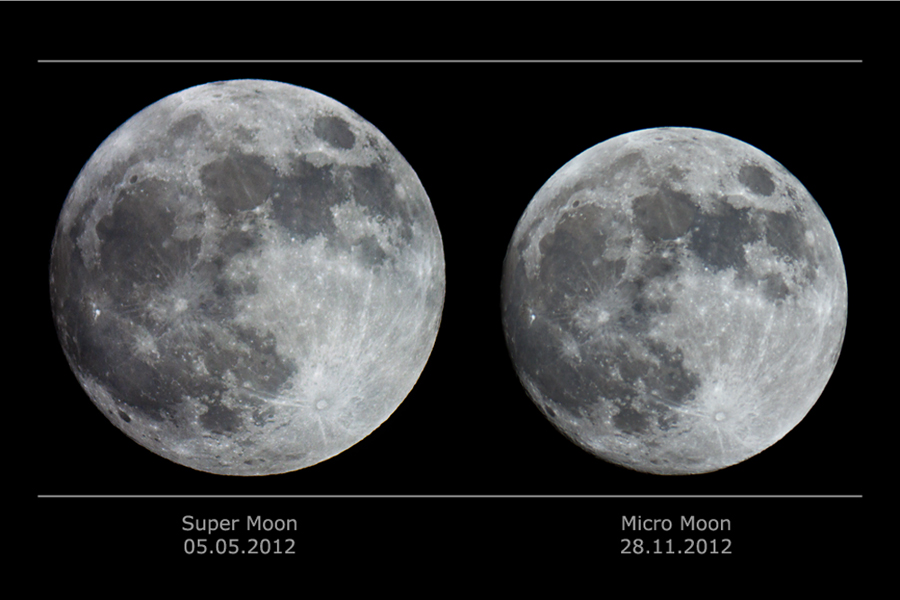
Perigree Moon and Apogee Moon


Perigree Moon and Apogee Moon (obviously not this dramatic to the naked eye; it was still bright enough to wake me up last night.)


Astronomy Picture of the Day

Discover the cosmos! Each day a different image or photograph of our fascinating universe is featured, along with a brief explanation written by a professional astronomer.
2012 November 29
See Explanation.  Clicking on the picture will download
 the highest resolution version available.
Super Moon vs. Micro Moon 
Image Credit & CopyrightCatalin Paduraru
Explanation: Did you see the big, bright, beautiful Full Moon Wednesday night? That was actually a Micro Moon! On that night, the smallest Full Moon of 2012 reached its full phase only about 4 hours before apogee, the most distant point from Earth in the Moon's elliptical orbit. Of course, earlier this year on May 6, a Full Super Moon was near perigee, the closest point in its orbit. The relative apparent size of November 28's Micro Moon (right) is compared to the famous May 6 Super Moon in these two panels, matching telescopic images from Bucharest, Romania. The difference in apparent size represents a difference in distance of just under 50,000 kilometers between apogee and perigee, given the Moon's average distance of about 385,000 kilometers. How long do you have to wait to see another Full Micro Moon? Until January 16, 2014, when the lunar full phase will occur within about 3 hours of apogee.

Tomorrow's picture: cloudy sky

18 April 2012

AT THE EASTER VIGIL


   The sky is still deep dark
   When pinpoints of people, like stars,
   One by one, in quiet procession,
   Precede the dawn.
  
   White hot Vega gazes down from overhead,
   And Arcturus shepherds us into a circle
   Around the slight spark,
   And now a fire, rising from Good Friday.

   When the bonfire roars, a bright blindness
   Transfixes our eyes, and flames,
    Rise still higher
   Until they cast a golden crown around
   Every face there.

   In that moment, I see no bodies
   Or fine clothes, or Easter bonnets,
   For they are still hidden in the darkness,
   Buried with the rest of our worries
   And evening pains, and Saturday graves.

   I see only faces, beautiful icons
   Glistening in resurrection glory,
   In moist anticipation of baptism,
   Just before sunrise.

   It is the only time we can ever look
    Directly at the sun,
   When it is on the horizon,
   At the edge,
   Of something new.              


20 September 2010

A RESPONSE TO BISHOP JOHN SHELBY SPONG

For the Sunday “Dean’s Forum”
The Cathedral of St. Philip, Atlanta
19 September 2010

Bishop John Shelby Spong has been visiting Atlanta and the Cathedral during the last three days, and I devote this Dean’s Forum to a review and response of his work.

I like Jack Spong. I invited him to speak at the Cathedral of St. Philip because we are a place of prayer for all people, and I admire his intellectual courage. He is a thinker, and he takes history and logic and science seriously. As many of you know, I love science and astronomy and physics. I like to take those subjects seriously, too!

This morning, I respond to his recent words with respect. He has a wisdom accumulated from many years of reading and teaching. He was educated at Charlotte, North Carolina public schools. He graduated Phi Beta Kappa from the University of North Carolina at Chapel Hill. He served as an Episcopal priest in Lynchburg, Virginia, and in Richmond, Virginia. Though I think he loves the South, as I do, he was also the Episcopal Bishop of Newark (New Jersey)!

And he was a loyal and controversial Bishop of Newark. He did much for the role of women in the Episcopal Church. He did much for the acceptance of the ministry of homosexual persons in the Church. And, as most of you know, I am in his camp on those issues. During those years, he was willing to tackle, and to talk about, all sorts of other important and critical issues.

But the other reason I like him, besides his being a Southerner, is that he knows the Bible! (Maybe he knows the Bible because he is a Southerner!)

However, I do not always agree with Jack Spong’s approach; and, thus, I do not always agree with his conclusions. I do think he is a man of faith. He claimed yesterday that he believes Jesus is Lord. That little phrase is key in the Christian life. He is a follower of Jesus. And anyone who follows Jesus is also a friend of mine.

Today, I want to review some of what he talked about, and I also want to respond. Some of what he produces can be quite unsettling to churchgoers. I heard from several people in this parish who were wary about his coming. I heard from others who were thrilled he was coming! In several respects, his questions are not my questions, but I know his questions are shared by many here at the Cathedral.

Thus, I need to respond. And, in fact, I love responding to him! I will speak first about what I admire and support in his presentations. Then, I will present some of my own concerns and differences in our way of thinking. Then, I will open this forum to questions and comments.

First of all, I admire the way Spong takes science, history, and contemporary scholarship seriously. This is critical in the spiritual life, and in the Christian life. He correctly joins the physical and the spiritual life. A good spiritual life is always physical!

He is right to complain that so many Christians avoid the hard questions. How can we believe that God lives somewhere high in the sky when we know that galaxies exist so far away from us?

Some of his examples are rather ridiculous, but when Spong obsesses on old literal features of the faith, he essentially reminds us that our belief system cannot be literal. Our faith should not depend on old scientific categories of sex and biology and physics.

I honor, and will always honor the liberal intellectual pursuit of truth, and I speak with Jack Spong against all forms of naïve fundamentalism. It is a shallow and fearful way of thinking; and it is a dangerous way to follow God.

I have many non-church friends in Atlanta, and around the world, who appreciate Spong’s willingness to tackle hard issues and engage the world. These are people who are seekers, who have not always found the institutional church accommodating to their questions. I want to say to them that we at the Cathedral of St. Philip do accommodate their questions. I believe God accommodates their questions.

I also admire the way Spong knows the Bible. He gets a few biblical citations wrong, but he knows his stuff. “It’s in the book,” he kept reminding us; and he’s right. The best way to learn not to take the bible literally is to read it.

Here is what he said at The Chataqua Institute recently: “Anything that is written down is always finite, mortal, human, and filled with error – error of perception if nothing else. For all words are time bound, all words are time warped. All words are the product of the age in which they were created. That never produces unchanging truth. That never produces literalism.” (from a recording of his Chataqua lectures –June 29, 2010.)

And this: “The bible has been used time and again for causes for which it is not worthy. When the Bible is used in public debate, it almost always loses…” (Chataqua lectures, June 29, 2010). This is so true.

“So much of the bible makes no literal sense,” he says. Spong tells the story of an astrophysicist who sarcastically posits that the doctrine of the Ascension of Jesus, when taken literally, means that Jesus has not left our galaxy yet, that is, if he was travelling at the speed of light, roughly 186,000 mile per second. This is one of those rather absurd examples, but it’s a fun one.

In particular, I like Spong’s dependence upon Paul Tillich, who wrote predominantly in the 1040s through the 1960s. I am a student of Paul Tillich myself – not literally, I mean; but I drank deeply at his well when I was in college and seminary. I wrote my college comps on Tillich.

Tillich talked of the God beyond god. He reminded us that every definition we have of god ultimately falls short of completely describing God. And he is right. Spong picks up on this when he says, repeatedly, over the weekend, that “our experience of God is not the same as our explanation of God.”

“Experiences are eternal,” Spong said at one time, “Explanations are not.” That is good stuff. Paul Tillich was acutely aware of how our explanations and descriptions of God could actually become idolatrous for us.

Our inclination is to defend our notion of God so vehemently that we miss understanding the real nature of the real God. And so Tillich set about re-framing even how we speak about God. He called god, “the God beyond god,” and “the Ground of our Being.”

I agree with Tillich. Those of you who have heard me preach and teach know that I like that phrase, “the ground of being.” God is that greater than which nothing is. Our very earnest and very thoughtful and very erudite descriptions of God cannot, and can never, completely contain and describe all of who God is.

Jack Spong speaks eloquently on these matters, and I enjoy listening to him. He is witty and insightful and very well-informed. And, finally, he is loving. Yesterday, here at the Cathedral, he ended up talking beautifully about the God of love.

It is by “living fully, and loving wastefully,” he said, that we experience the fullness of God in our lives. Living fully and loving wastefully.

I agree with that! But those are not new phrases in the Christian religion. “Loving wastefully” is what the prodigal father did, in the parable we name “the prodigal son.” (The word “prodigal” means wasteful or extravagantly lavish). Ireneaus, back in the second century AD, is famous for uttering, “The glory of God is a human being fully alive.” Living fully. That is exactly what Jack Spong is saying 1900 years later. The glory of God is a human being fully alive.

However, let me say some words, some important words, about how I see God – and religion—differently from Jack Spong.

Again, it may be that he and I understand and speak of God in quite similar ways. But Spong is far more critical of religion than I am. He continues to complain that our language is outmoded, that it cannot carry the meaning that it should anymore. He complained all through his talk about the old prayers of our prayer books. Too much emphasis on miserable humanity. Too much singing about blood.

On the surface, he is right. (That’s why we don’t use the 1928 Book of Common Prayer anymore!). Religion cannot be based literally on the wretchedness of humanity and the blood of Jesus. Religion is always in danger of stifling human creativity and oppressing people with its power. Religion can be a burden. I hope we all know that.

But here’s a major difference between Jack Spong and me. Jack Spong takes things far more cerebrally and materialistically and objectively than I do. He takes things like religious language far more literally than I do.

I believe that religious language, and biblical language has a far more poetic and imaginative dimension than he seems to. For that reason, religious language can carry the weight of many, many more interpretations than just a literal one.

When I say the Nicene Creed, for instance, I am not thinking about the literal circumstances of how Jesus might have been born of a woman who had never had sex. That is just not part of what I am doing when I say the Creed.

What I am doing is stretching the limits of my imagination about the holiness of Jesus, and the open and willing faith of Mary his mother. For me, the doctrine of the virgin birth is a miracle – or sign, because I do think “sign” is a better word – because transcendent God deigns to be manifest in ordinary human flesh. I do not need a biological answer to the virgin birth question. Jack Spong’s questions, on the other hand, do seem to need a biological answer.

I simply do not read the bible, either, as pure science or pure history. I am not bothered about whether Jesus literally ascended from the earth forty days after his resurrection. The doctrine means much more to me than a man flying around after his death.

You who come to church Sunday after Sunday, and you hear us Episcopal preachers take on the themes of feast days – like the Ascension, Pentecost, even Easter itself—you hear us do the work of translation. You hear us translate the biblical and liturgical and religious images into something – we all hope—is meaningful today!

There was one line in Jack Spong’s last book that was most revelatory for me. Now, many lines were revelatory; but there was on passage , in particular, that described a major difference between him and me. It is towards the end of the book, when he describing how much he has read. (You who heard Spong know that he likes to talk about how much he has read and who he has talked to!)

He says that, as Bishop of Newark, “I developed a passion for reading books on tape. This was before the days of iPods. While driving around the diocese, I was always listening to a book via my tape-player. I managed in this way to read some eighty books a year during my twenty-four-year career as bishop. Almost none of these books were novels, which appealed to me almost not at all. They were rather history, biography, science, political science, economics, and psychology.” (page 199, Eternal Life.)

He says that he took time to read, but that he read no fiction, no novels, no poetry. That is the difference. That is the difference between his study and mine. I need the poetic and artistic imagination. For me, authentic religious language is about creativity and imagination. It is poetry, not science.

Apparently, when he was at Chataqua earlier this summer, Jack Spong mentioned that he had had a conversation with Alan Jones, the former dean of Grace Cathedral, San Francisco. Alan is an old friend of mine, too; and I know Alan thinks far more like me than like Jack Spong. Anyway, Spong mentioned that he had decided how he was different from Alan Jones. Spong said that he, Spong, was a left brain thinker; and Jones was a right brain thinker. That’s another way of describing how I, too, part ways with Jack Spong. I am a right brain thinker; he is a left brain thinker.

Right brain thinking has driven my own poetry and imagination and art and music. Left brain thinking is about objectivity and mechanics. This may be a reason that, while I like Jack Spong, I do not follow him closely. His dilemmas are not my dilemmas. It does not bother me that the virgin birth cannot be described scientifically. That is exactly its power. Christian doctrines are not meant to be scientific and literal for me.

I need church, because I need the history of words and traditions that have carried many, many levels of meaning. The word is “multivalent.” Religious language, and religious symbolism, have multivalent meanings. Good words of any sort carry a multitude of meaning. They do not mean only one thing. Poets know this. Fiction writers know this. Religious people know this. So, liturgical words are difficult, but they are important.

I cannot follow fundamentalism of any sort, whether it be conservative fundamentalism or liberal fundamentalism. Fundamentalism is the inability to admit that one might be wrong. Fundamentalism is any closed system which cannot admit questioning and critique.

Let me say a word here about the wider Episcopal Church, beyond Jack Spong. In the Episcopal Church right now, fundamentalists of both liberal and conservative persuasions are commanding most of the public conversation. Their polemic, and the way the media presents the polemic, has made much of the public oblivious to a vast and broader Episcopal way that refuses to be constricted by fundamentalism. Some people call this vast and broad way a “Middle Way.” I prefer the phrase, “Comprehensive Way.”

An Episcopal comprehensive way discovers truth along both extremes. A comprehensive way does not simply stay in the middle and avoid extremes. The greater way is able to see truth at both poles of an orbit, but the greater way does not stay at either particular pole.

There was one more thing Jack Spong did say yesterday about the Church that I appreciate. Someone wisely asked him, “If he believed all this, why should anyone go to church?”

He replied that our task was to be fully human, fully alive, and no one becomes fully alive, no one loves fully, as an individual. Becoming fully human, and loving fully, is a communal activity. I agree. That is one of the great reasons to participate in the messy, crazy, faithful, betraying community we call Church. We stumble over language in the church, we hurt each other, but we also forgive each other, we get it right a lot, and we love one another into the fullness of humanity.

Finally, Jack Spong has declared in many places that that religion is dying. I suppose that comment is designed to wake people up, so that they will become aware, and do something. But, again, that is not a new comment for me.

For me, everything is dying. We are always dying. That is one of the chief pieces of religious wisdom that informs and inspires me. That principle is at the heart of classical Christianity.

So, if someone asks me, “Is traditional Christianity dying?” I answer, “Of course it is.” Christianity is always dying, but it is always being reborn, too. We are always carrying about the death of Christ, and I quote two magnificent passages from Paul’s Letters to the Corinthians:

But we have this treasure in clay jars, so that it may be made clear that this extraordinary power belongs to God and does not come from us. We are afflicted in every way, but not crushed; perplexed, but not driven to despair; persecuted, but not forsaken; struck down, but not destroyed; always carrying in the body the death of Jesus, so that the life of Jesus may also be made visible in our bodies. For while we live, we are always being given up to death for Jesus’ sake, so that the life of Jesus may be made visible in our mortal flesh. (2 Corinthians 4:7-11).

And, one of my favorite verses of all time, “Listen, I will tell you a mystery! We will not all die, but we will all be changed.” (1 Corinthians 15:51).

We will not die. But we will be changed. Paul spoke of our individual bodies. But he could as easily been speaking of the Christian Church. A healthy church is always dying to something, and being reborn into something else. That cycle is at the heart of who we are.

In fact, it’s another reason to belong to church, to belong to a Christian community, to participate in religious ritual. That ritual, and that rich, poetic, language, teaches us how to change gracefully. How to die gracefully. How to be born again gracefully.

The reason I disagree with Jack Spong on the matter of religion is that I take the word “religion” in a much broader way than he does. I think religion is inevitable. Many of you have heard me speak on the question, “What does it mean to be spiritual and not religious?” My answer is, “It doesn’t mean much.” The person who is spiritual and not religious does not have a community; does not a body. Probably does not have a life.

Because every structure is a religion of some sort. Religion is inevitable! If you are a Jack Spong groupie, you could gather all his books up and compile your own ritual and liturgy. Of course, he would be appalled if you did that. But the point is that you can take his words, too, and create a limiting, finite structure that would qualify as a religion. But if you didn’t build on those words and thoughts, they would be out of date by tomorrow.

At its worst, science can be an unchanging religion, too! The scientist who refuses to grow, who becomes a fundamentalist, is also dangerous. A few years ago, Krista Tippett interviewed on her radio show (“Speaking of Faith”) a geneticist named Lindon Eaves. A curious part of Dr. Eaves’ life is that he is also an Episcopal priest. Lindon Eaves, an Episcopal priest and a geneticist, offered these remarks:

“If you really look at human experience, the truth is that we're all living a life of experiment, and I mean in every aspect of our lives. I mean, you know, the — so you can — you can either think of let's say the creeds of the great traditions, as it were, as telling you what you ought to think, or you can say they are in some sense comparable to theories of science. They are the best distillations of where we've been. But we don't approach reality treating those models as if they're the last word. We treat them as operational hypotheses.”

I loved that comment. What if the creeds are operational theories in the same way that scientific theories are? That makes a lot of sense! We need both of them to live fully and to love wastefully

Every structure, and organization, in our human life is a religion of some sort. And every religion is a “theory” of some sort. I do not mean a theory like a guess. I mean an operational theory, a theory that we need. I mean a theory that works, like the theory of evolution. There is no way to be a scientist without a theory, and there is no way to be spiritual without being religious.

So, yes. Traditional religion is always dying, but it is always being born again, too. I believe in the Resurrection part. I say, “Be a part of its death if you must, but try to be part of its resurrection, too.” It’s the reason I am gladly and faithfully, not just a Christian, but also a member of the Christian Church.

The Very Reverend Samuel G. Candler
Dean of the Cathedral of St. Philip
Atlanta, Georgia
19 September 2010

15 September 2009

THE HEAVENS DECLARE THE GLORY OF GOD


(a sermon from 13 September 2009 -- Proper 19B of the Revised Common Lectionary)

The heavens declare the glory of God,
And the firmament shows his handiwork.
One day tells its tale to another,
And one night imparts knowledge to another.
Although they have no words or language,
And their voices are not heard,
Their sound has gone out into all lands,
And their message to the ends of the world.
-Psalm 19:1-4

The heavens declare the glory of God!

At one time in human history, religion and science were faithful partners.

Nicholas Copernicus, who published the idea that the sun was at the center of the solar system, was also a Canon at Frauenberg Cathedral. Johannes Kepler, the first true astrophysicist, who realized that orbits are elliptical, originally wanted to be a Lutheran minister; he wrote in 1595, “for a long time I wanted to become a theologian….now, however, behold how through my efforts God is being debated in astronomy.”

Isaac Newton, whose theology was unorthodox and erratic, nevertheless actually wanted his science to convince people of the existence of God. Robert Grosseteste, whose work in optics laid out the basis of the western scientific tradition, and which prepared the way for Galileo’s telescope, was a bishop, the Anglican Bishop of Lincoln. Roger Bacon, who championed experiment and scientific method, was a Franciscan monk.

These early heroes of science did not find that their religion contradicted their pursuit of scientific truth. And much scientific pursuit had its origin in observing and studying the heavens. The sky, especially the night sky, displayed movement that looked orderly but also could not be exactly quantified. Which heavenly bodies moved around what?

I believe that even Albert Einstein had a deep spiritual streak, even a mystical streak. Even in his time, the orbits of the planets could not be exactly quantified or predicted. It is said that Einstein first tested his theory of relativity in 1915 by applying it to the orbit of the tiny planet Mercury. Lo and behold, he found that his theory explained the discrepancy in relation to Newtonian theory. His biographer, Abram Pais, said, “This discovery was…by far the strongest emotional experience in Einstein’s scientific life. Nature had spoken to him.” (Jonathan Polkinghorne, Belief in God in An Age of Science, New Haven: Yale University, 1998, page 3.)

The heavens declare the glory of God.

I celebrate this morning the language of God. It is not just in words that God speaks to us. God speaks through the language of math and science. God speaks through the heavens; God speaks through the earth.

Some of our great poets know this: “The earth is charged with the grandeur of God,” said Gerard Manley Hopkins. And I will always love these sweet lines of Elizabeth Barrett Browning,

Earth's crammed with heaven,
And every common bush afire with God;
And only he who sees takes off his shoes;
The rest sit round it and pluck blackberries.

Only he who sees takes off his shoes.

I was actually wearing shoes last week, running shoes. I was doing my morning jog, trying to exercise off the weight I gained at the end of the summer. During those jogs, I am accustomed to dodging various hazards in the road and on the sidewalk. You know what the hazards are. Suddenly, right below, my feet were dodging a fallen butterfly. I don’t know much about butterflies, but it was some sort of swallowtail. I stopped and examined its beauty. My mere act of pausing to observe it made me aware of so much more life –divine life—all around me.

Later that day, I saw the most recent photographs from our repaired Hubble telescope, whose lenses are trained on galaxies far, far away. One of the most dramatic photographs was of the Butterfly Nebula (there are actually two nebulae that are sometimes called the Butterfly Nebula; this one was NGC 6302). I knew that the God who created that delicate butterfly on the sidewalk of Atlanta is the same God who created that exploding Butterfly Nebula so many light years above us.

The heavens declare the glory of God – that is, if we pay attention. There is no contradiction between the language of God in words and the language of God in science.

The medieval scholars considered that there were two divine books. One was the book of scripture. The other was the book of nature. They knew that there is something in God’s creation that speaks to us of God. It was one of my heroes, St. Anselm, who named the strategy of “Faith Seeking Understanding,” “fides quarens intellectam” as a principle for the relationship between faith and reason. Reason and faith and not meant to oppose each other. Rather, it is faith that inspires us to use reason to its fullest extent.

All truth, no matter where it comes from, is God’s truth. This principle is what enabled great thinkers to investigate the stars and the seas, to boldly go where no one has gone before –not just in space, but in medicine, in physics, in biology, chemistry, history and archaeology. All truth is God’s truth.

The person of faith, then, is not the idiot fanatic who cringes away from science and investigation. The person of faith is the scientist who leans forward into discovery and exploration.

There is a certain principle, a certain discipline, which lies at the heart of both spirituality and science. It is the discipline of paying attention. The discipline of observation.

Good science is about good observation, paying attention to things. I believe that discipline is also at the heart of good spirituality. “Watch,” says Jesus over and over again toward the end of his ministry. Pay attention. Give heed. The great mystics of prayer and contemplation say the same thing: prayer is about paying attention. When we pay attention to life, we begin to recognize the presence of God in life, in all life.

Psalm 19 ends just as gloriously as it begins. It begins with “the heavens declare the glory of God.” The entire universe. The entire created order. The universe roars with the presence of God! But the psalm ends much more intimately, more quietly with these words:

“Let the words of my mouth, and the meditation of my heart, be acceptable in your sight, O Lord, my strength and my redeemer.”

The glory is that God is not only in the heavens. The glory of God is also inside each one of us. The God who speaks through the universe is also the God who speaks to each of us in the meditation of our hearts. (This is the feature of divinity that Richard Dawkins, writing in The Wall Street Journal on September 12, 2009, does not understand.) The God who is awesome and glorious, is also the God who is intimate and close – as close to each one of us as our own heart is.

If we pay attention. If we watch, if we listen, then God is within the intricate process of our own bodies just as gloriously as he is in the heavens. God is in the Butterfly Nebula, and God is also in the butterfly dancing in Atlanta. God is in the joyous explosions of our individual hearts, and God is also in the nervous butterflies of our guts!

In our time, much nonsense competes for our attention. Vanity and violence allure us to television and movie screens, and cell phone screens. We glorify too much empty thought, too many offenses in our time. Psalm 19 calls us back to the law of the Lord, too, that which will revive the soul.

Where are you directing your attention today? What are you spending your time doing? If you are paying attention to something life-giving and wholesome and beautiful and good, you are listening to God. Look to the heavens. Look to the meditation of our own hearts. The heavens declare the glory of God, whether those heavens are above us are inside us.

The Very Reverend Samuel G. Candler

14 August 2009

PERSEID METEOR SHOWER and CREATIVITY

I actually read the Wall Street Journal for both financial and other kinds of news! Since my birthday always falls at the same time meteors from Perseus fall, I am especially intrigued by this article, titled "Cosmic Creative Destruction on a Cosmic Scale."

24 July 2009

ARTIFICIAL DEVICES

ARTIFICIAL DEVICES

A few days ago, I was leaving Anaheim, California. The work of the General Convention of the Episcopal Church was good and important, but I was ready to depart that region. The setting –a convention center in Anaheim—seemed artificial and unseasoned, without a history or developed character. In fact, the character of the place was Disneyland; how much wisdom or character can one hope to imbibe from an amusement park?

Nevertheless, that setting was my home for two weeks. My routine was the same. Rise early, prepare for committee meetings, encounter ideas and faith and people and agendas, walk from one air-conditioned room to another, ride on escalators and elevators, eat processed food quickly and absently, sit on the legislative floor and pay attention, do all this some more, and then try to be asleep by 11:00 so I could rise again at 5:00 am.

I must admit that, for all its sterility, the Anaheim Convention Center, with two central hotels, was a comfortable place to gather and do business. Yes, it was artificial; yes, it was also mechanically efficient for us.

Then, one day after I left Anaheim, I was sitting on a dock in Canada with my father, just after sunset. Since my childhood, I have travelled annually to that lake, with its rustic cabins and primitive challenges. The deep green hemlocks and pines, the rich white birch trees, the cold black water, the open sky, all overwhelm any human activity; artificial devices are weak and meager here. It is easy to be mesmerized by the sky.

With a few others, my father and I peered eagerly into the northwest horizon, waiting and watching. A slight cold front was breaking up the overcast day. The air was chilly, but the sky had cleared above some post sunset clouds.

Then, suddenly, we saw it. The International Space Station was soaring over the north. The orange white glow was speeding at 17,000 miles per hour, 405 miles away from us. In the twilight, only Vega and a couple of other stars were beginning to appear. But, as we focused on this man-made intrusion into space, we also made out distant objects way beyond humanity’s foray into the heavens.

I have watched that northern horizon many a night here in Ontario. I have seen amazing light shows from the Aurora Borealis. It is always beautiful. If “artificial” means man-made, or simulated, or forced, or contrived, then this part of God’s creation is the very antithesis of “artificial.”

But for humanity, “artificial” is all we have. All we can muster, by definition, are man-made attempts and offerings. In fact, the International Space Station, a true modern marvel, is the very height of “artificial.” It is a man-made contrivance, inserted into the far reaches of God’s creation. Though it is the result of creative science, it is also a piece of art, like a paint stroke across the sky’s canvas.

Yes, the International Space Station is a work of art. It reminds me of a deeper meaning to the word “artificial.” Etymologically, “artificial” can mean “belonging to art,’ or “made by art.” At our best, we human beings create from artistic desire. We plan, and build, and explore, with artistic visions.

One of the many marvels about the space station is that it is also a work of art by committee. It has been added to, and revised, and corrected more times than…well, more times than an urban office building, or an old house, or… a piece of government legislation.

The old adage is that one will never eat sausage again after one has seen the inside of a sausage factory and how the stuff is actually made. One will never want to enter politics after witnessing the journey of a single piece of legislation. One will never want to go to church again after serving on a vestry or board of elders.

But those factories and legislatures and vestries are all we have. All we have are artificial attempts, human-made pieces of art, often assembled by committee, to witness to truth and grace in the world. That’s what the General Convention of the Episcopal Church was. Yes, it was set in an artificial place (a place designed to work!), it was committee after committee, it was the work of humanity. I hope and pray, nonetheless, that it has served us well.

Artificial devices are all we have on this earth, and all we have above the earth. At their best, they are truly works of art, inspired by glorious visions. For all our foibles, the Episcopal Church has a glorious vision; we want to be orthodox and generous, faithful and honest. We want to be true to God and to God’s creation. We are human beings, but we are on the dock straining to see grace over the horizon. We are human beings, but we have glimpsed divine grace in the twilight.

(This article also appeared at a website named Episcopal Cafe (here), for which I write from time to time.)

21 July 2009

The Heavens Tell of the Glory of God

At 10:31 tonight, the International Space Station will pass over my head, just after a solar eclipse occurs on the other side of the world.

Enjoy!