Showing posts with label Science and Math. Show all posts

07 January 2016

SAND DOLLARS AND STARS


It's been almost a hundred years since the sand dollar looked like a dollar. Our dollars have turned from gold to silver, and from round discs to sheets of paper. Now, our dollars are figures on a check, or digits on a credit card, or maybe just a swipe of our smartphone.

But the "sand dollar" name persists. It is the name of a lovely shell, a skeleton, really, along the Atlantic coast, and in oceans around the world. Alive, the animal has little spikes, and thus is one of the echinoderm phylum of animals. The word "echinoderm" means "spiny-skinned." The sand dollars that I find on the beach are flaky gray discs, with a beautiful five-pointed star pattern on one side.

That five-pointed star pattern is a good clue that the sand dollar is actually related to the starfish, or what we call the starfish. The true name of the starfish (not a fish, per se) is the sea star.

At the Feast of the Epiphany, we in the Christian Church pause to celebrate a star. It was the sign of a star that led wise men from the east to be searching for the one who would be messiah and who would shepherd God's people. They found the child Jesus.

That star, and stars in general, continue to be signs for us of the light of the world. Somehow, stars indicate a mysterious and powerful light, light that comes to us not just in one line, but in various rays. Light radiating out from its core, in several rays, is what we call a star. Often, we give five rays to a star, but there are obviously so many more.

One of the features of sea stars is that when an arm, or ray, is broken off, another one grows in its place. Its body is able to regenerate. (Echinoderms are known for their radial symmetry.) Such is the power of star light, too. It is able to regenerate.

When we look for light in our lives, we are looking for something powerful enough to regenerate, powerful enough to touch us again and again. We may be looking for something spectacular and heavenly, but the true lights of the world can come from most anywhere. True lights of radiating mercy can come from right beside us, in someone we know. Or from someone we don't know. True lights of radiating mercy may even come from the ground below us, from the ocean mud and the sand.

True lights of radiating mercy can come to us in the form of a gray and flaking skeleton on the beach, a sand dollar. It may look like old currency, but there is something holy in it. It has carried the value of spirit in times past, and it can carry the value of spirit again.

During this season of Epiphany, I want to find the stars of heaven. Those stars may not be in the skies. They may be in the sandy beaches of our state. They may be in what the waves and water have washed up and left behind. With God, there is another chance. God wants to show us light, and God will regenerate that presence, again and again, if we need it.


I hope you find some of God's sand dollars this season. They won't buy you a thing at the shopping mall, but their value will be unsurpassed. They will have the ability to show us, again and again, that God's light and God's love are eternal.

13 October 2013

THE HIGGS BOSON, THE GOD PARTICLE, THE CHRIST

The naming of the Nobel Prize for physics is always cool. But it is especially cool this year, because the winners were involved in the conceptualization and discovery of the Higgs Boson, a particle so tantalizing and theoretically necessary that it came to be called the “God Particle.” Congratulations to Peter Higgs and Francois Englert, winners of 2013 Nobel Prize in Physics!

The Higgs Boson, a sub-atomic particle, was theorized many years ago as the particle which allows other particles to have mass. (Higgs and Englert were the first to document its possible existence, way back in the 1960’s.) I make no claim to know theoretical physics, but the Higgs Boson is apparently the reason other particles in our universe cohere together instead of simply flying off in a hundred million different tiny directions (okay: many more than a hundred million).  If your physics knowledge is as shallow as mine, you might enjoy the short and delightful explanation in this video: “The Higgs Boson Explained.”

But I was going to talk about God. Since it was theorized so long before its actual detection (detection came in July of 2012, at the Large Hadron Collider), the Higgs Boson came to be called the “God Particle.” It was the reason every other particle had mass. It was the reason every other particle came to be created; it was, and maybe is, the “God Particle.”

Well, I like that name: the “God Particle.” Yes, God is someone I talk about a lot. God is someone I have theorized about, though I have sure had a hard time detecting God sometimes. Yes, God is someone I have spent a large part of my life trying to discover. My understanding is that many, many other people have been trying to discover God, too!

It used to be that we thought the “atom” was the smallest indivisible particle of the universe. Over two thousand years ago, the very word was formed from “-a,” meaning “not,” and “temno,” meaning “cut.” An “atom” is uncuttable, indivisible. As recently as the nineteenth century, we considered the “atom” the smallest indivisible part of creation.

But we’ve come a long way in a hundred years. We human beings have discovered that atoms consist of protons and electrons and neutrons, and then they consist of leptons and quarks and muons and charms and stranges and who knows what else. And it goes on and on. I am convinced that it goes on and on. I want our discovery to go on and on. The world is a better place when we make scientific theories and discoveries and confirmations.

However, I have another hypothesis for what we might truly call the “God Particle.” I discovered an energy long ago, which I believe is responsible for life and growth and energy at all levels of existence. It goes by many names, but I have come to call it the “Christ Particle.” And it is not restricted to Christians (Raimundo Pannikar writes about The Unknown Christ of Hinduism.).

It is the Christ Particle which creates life and makes things hold together. From primal elements, creation is formed; the Christ is the power of that creation. From dismal misery, love explodes; the Christ is that power of love. Even in times of destruction and betrayal, the Christ brings forgiveness and reconciliation. That power is massive and incredible. It is also the Christ energy which inspires learning and discovery!

The Christ Particle will never be measured by our technology and machines. It is undiscoverable by empirical or scientific means. I have nothing against science. We need empiricism and science; in fact, we need more of it! But science will never discover this particular God Particle. This Christ Particle is what we are looking for, the energy point of creation. It is why other particles attract to each other. One might even claim that the true Christ particle is the opposite of entropy. It is the energy particle, the ultimate force that loves us together.


Yes, it is the smallest particle in the universe. But, it is also the largest. It is the most mysterious, and it is right before us every day. Blessings to all who seek the seemingly impenetrable secrets of the universe; I am pulling for you, and you will go on and on! But blessings, too, to who all who seek the mystery of Christ, who is the image of God, and in whom all things hold together. “Christ is the image of the invisible God, the firstborn of all creation; for in Christ all things in heaven and on earth were created, things visible and invisible, whether thrones or dominions or rulers or powers—all things have been created through Christ and for Christ. Christ himself is before all things, and in Christ all things hold together.” (Colossians 1:15-17).

Sam Candler

(This article was originally published by Sam Candler at Episcopal Cafe, 12 October 2013. Thank you!)

29 November 2012

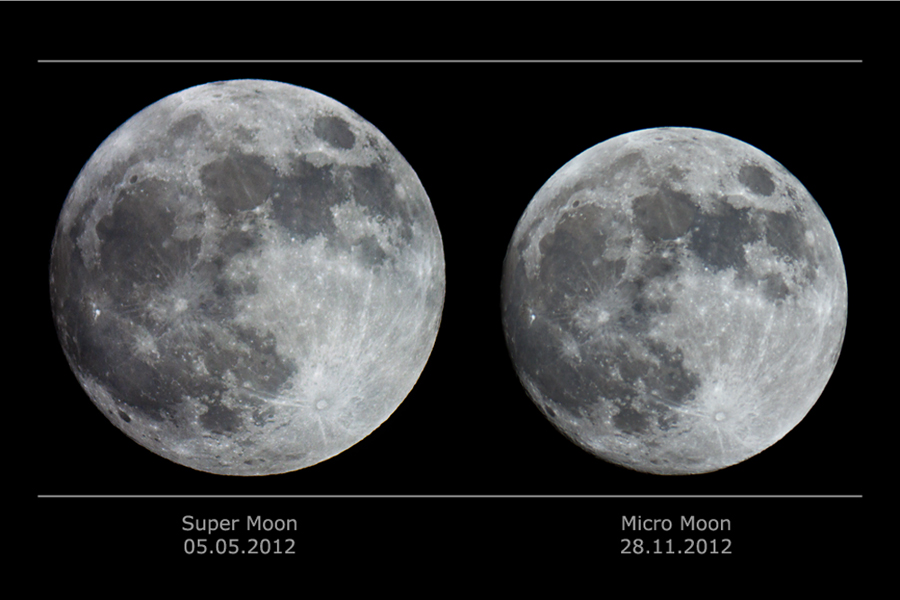
Perigree Moon and Apogee Moon


Perigree Moon and Apogee Moon (obviously not this dramatic to the naked eye; it was still bright enough to wake me up last night.)


Astronomy Picture of the Day

Discover the cosmos! Each day a different image or photograph of our fascinating universe is featured, along with a brief explanation written by a professional astronomer.
2012 November 29
See Explanation.  Clicking on the picture will download
 the highest resolution version available.
Super Moon vs. Micro Moon 
Image Credit & CopyrightCatalin Paduraru
Explanation: Did you see the big, bright, beautiful Full Moon Wednesday night? That was actually a Micro Moon! On that night, the smallest Full Moon of 2012 reached its full phase only about 4 hours before apogee, the most distant point from Earth in the Moon's elliptical orbit. Of course, earlier this year on May 6, a Full Super Moon was near perigee, the closest point in its orbit. The relative apparent size of November 28's Micro Moon (right) is compared to the famous May 6 Super Moon in these two panels, matching telescopic images from Bucharest, Romania. The difference in apparent size represents a difference in distance of just under 50,000 kilometers between apogee and perigee, given the Moon's average distance of about 385,000 kilometers. How long do you have to wait to see another Full Micro Moon? Until January 16, 2014, when the lunar full phase will occur within about 3 hours of apogee.

Tomorrow's picture: cloudy sky

15 March 2011

ARE WE PREPARED?

With sadness in our hearts, and with horrifying images of devastated Japan still in our minds, many of us began the First Sunday of Lent with a plaintive series of prayers called “The Great Litany.” Here at the Cathedral, we sang it in procession, walking completely around the Cathedral nave, twice, before entering the altar. From The Book of Common Prayer, page 149:

“From lightning and tempest; from earthquake, fire, and flood;
from plague, pestilence, and famine;
Good Lord, deliver us.

….From dying suddenly and unprepared;
Good Lord, deliver us.

The earthquake, then the tsunami, then the loss of power and water, then the nuclear radiation emergency have rolled across Japan just like one earthquake itself, with wave after wave of tremor and terror. As I write these words, and a few days later as you read them, still another emergency may have developed.

We keep the people of Japan in our prayers. We keep the people of the Middle East in our prayers. We keep in our prayers all those threatened by natural disaster and political disaster. Lent is a season for prayer. And Lent is a season for self-examination.

The news media, meanwhile, peddles both news and anxiety; and their tradition goes back a long way. It was George Bernard Shaw who said, “Newspapers are unable, seemingly, to discriminate between a bicycle accident and the collapse of civilization” (see The Week magazine, March 11, 2011, page 23).

Obviously, news such as the earthquake in Japan is serious and anxiety provoking enough; it is certainly a collapse. Still, after a few days of reviewing the destruction, one headline on the television caught my eye. “Are We Prepared?” it asked. The newscasters had begun to turn their eye to the United States of America, and, especially to our earthquake preparedness and nuclear emergency preparedness. I knew, immediately, what they would conclude. “No,” they would say, “in many ways, we are not prepared.”

To which I respond, “Of course we are not fully prepared.” There is no way, in this complicated and mysterious world to be fully prepared for every possible disastrous scenario. When we believe we have fully protected ourselves from one sort of calamity, a completely different one will surprise us. Of course, I fully support all our material efforts at protection. I believe in the work of scientists and good politicians who truly seek the common good. It is good to think and to prepare.

But there are other ways of being prepared, than simply scrambling aimlessly to avoid physical death. I notice, for instance, the amazing sense of order and collective good in the Japanese people. I have heard little about looting and opportunistic violence there; on the contrary, people are caring for one another with amazing good will. Such behavior indicates that their spirits have, indeed, been prepared.

“Are we prepared?” True preparation involves much more than just spending on physical infrastructure and stocking food and water in our basements. True preparation involves knowing how to care for other people in the midst of tragedy, even in the most unexpected kinds of tragedy. True preparation involves knowing how to live with grace and honor even in the midst of death.

True preparation is a matter of our spirit, and the Church has been in the business of preparing our spirit for a long time. Our prayer, our coming together for nourishment and service, our spiritual disciplines, are all ways of preparing ourselves. Our Lenten self-examination is a way of preparing ourselves.

Sadly, we will all die. We admitted as much on Ash Wednesday, when the priest touched us and said, “Remember that you are dust, and to dust you shall return.” But “from dying suddenly and unprepared…..Good Lord, deliver us.”

25 May 2010

MARTIN GARDNER HAS DIED

Martin Gardner was my guide as I wrote my Easter sermon of 2010, "Easter in 3-D! (Or, Believing Six Impossible Things Before Breakfast)" What a delightful man and delightful vocation! He has now died, and I remember him gratefully. Through the mercy of God, may his soul rest in peace.

Douglas Martin's obituary, in the New York Times, begins this way:

Martin Gardner, who teased brains with math puzzles in Scientific American for a quarter-century and who indulged his own restless curiosity by writing more than 70 books on topics as diverse as magic, philosophy and the nuances of Alice in Wonderland, died Saturday in Norman, Okla. He was 95.

...Mr. Gardner also wrote fiction, poetry, literary and film criticism, as well as puzzle books. He was a leading voice in refuting pseudoscientific theories, from ESP to flying saucers. He was so prolific and wide-ranging in his interests that critics speculated that there just had to be more than one of him.

His mathematical writings intrigued a generation of mathematicians, but he never took a college math course. If it seemed the only thing this polymath could not do was play music on a saw, rest assured that he could, and quite well.

“Martin Gardner is one of the great intellects produced in this country in the 20th century,” said Douglas Hofstadter, the cognitive scientist.