The day had already been satisfying and successful. I had led a men’s retreat on a beautiful piece of property about an hour and a half south of Atlanta, Georgia. The crisp November air had nourished a new sparkle in the oak and poplar leaves. Some of us went fishing; some of us shot guns. The trailing wind and rainy remnants of a distant hurricane had came through and opened up the night sky, revealing a thick and lush panoply of stars.
Out in the open country, the retreat itself was also thick and delightful. I remembered how Herodotus described the war discussions of the ancient Persians. Apparently, when deliberating about whether to go to war, they made such decisions twice. First, in the steady light of reason and tempered discourse, they reached one rational decision. Then, apparently, they would engage the same question while they were drunk. If they came to the same decision in both situations, they would act on it.
So it went on our men’s retreat. After Thursday night, on Friday, we discussed manhood and spirituality. What are the masculine features of a healthy spirituality? What does it mean to be a liberated man in our current economic situations? What is the love of the father, and why are there masculine images for God? We considered the four archetypal “soul types” that Richard Rohr presents in his book, “From Wild Man to Wise Man.” (those types are king, warrior, magician, and lover; more about those soul types on another day.)
On the way back to Atlanta, I drove through the county where I had grown up. I was actually trying to get to the county airport, where my son was preparing for a two hundred and fifty mile cross-country airplane trip. He has been obtaining the necessary licenses to be a commercial airplane pilot. But I just missed him. By 2:00 pm, he had already left with his instructor, flying southward. I texted him with our familiar family lines: “Have fun and be careful.” Those lines have informed our family blessings for almost thirty years.
Back home in Atlanta, I sat outside to catch up on mail and necessities. Given the late hour of my previous evening, I thought perhaps I should take a nap. But then, I heard the sounds.
I heard the familiar, wonderful, and guttural sounds. They sound like gurgles first, so clear and so loud – especially so on a crisp fall afternoon in Georgia. But they cannot be true gurgles, for they come from above, from the air. I have heard them almost every year of my fifty-three years. They are as dependable as these flaming November leaves on maple trees before me.
They were sandhill cranes. I counted at least eighty of them, not far above me this year, undulating in the breeze, substituting the lead, flanking out asymmetrically and raggedly. They were beautiful. This year, with the crisp afternoon sun on them, I could observe astounding detail in their necks and heads.
They were flying right over the developed city of Atlanta, which is nevertheless still blessed with trees and some open land. No matter how congested the Atlanta traffic becomes, and no matter how frantic our daily human lives are at this time of year, the sandhill cranes are an annual prayer flag for me. God sends them fluttering southward in the wind. They are being led and piloted by a power that has existed long before I was born.
Inevitably, I always hear the birds before I see them. So it is, Jesus said, with those born from above, those born of the wind of the Holy Spirit. “You hear the sound of the wind, but you cannot tell where it comes from or where it goes.” The Holy Spirit pilots those birds up and down the continent every year.
This year, I am waiting for that telephone call or text message or email from another pilot, my son. No matter how different he is from me, and no matter how much he faithfully differentiates himself from me, still, a piece of me is with him all the time. A piece of me is up there with him in the Cessna airplane right now, flying freely to the south.
This year, my spirit has leaped up to join the sandhill cranes. Maybe I can fly with them. I’ll try to catch up to that airplane that took off a few hours ago. It has landed now, and the cranes will catch up to him. I hope he remembers to look up, even after he has landed. Even after he has succeeded in the day’s challenge, I hope he remembers to pause and to look up.
I think he’ll see those same sandhill cranes flopping and flapping overhead. They are always there this time of year, but most humanity in this generation has never seen them.
The Holy Spirit, too, is flying over us – and maybe through us and among us; but we will not glimpse that power until we pause and look around. Maybe we will look up, on a retreat; maybe we will have to look down, toward our own children. Maybe we will hear the Holy Spirit before we see anything, and maybe the sound will seem like guttural foreign tongues. The Spirit speaks like that sometimes. But she always soars, and she always waves for us to follow.
(This piece was also published at www.episcopalcafe.com. Check it out!)
23 November 2009


22 November 2009
The Ad for The Episcopal Church in USA Today
Here is the Episcopal Church ad that appeared in the "USA Today" newspaper last week:
(click on it to see it more clearly and legibly)
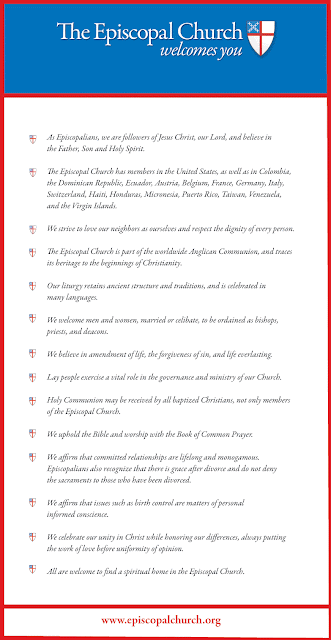
Some have criticized the ad for being too wordy, for trying to say too many things, or for not being visual enough. I, however, did not mind it. It seems to me that this ad uses brief summaries of our doctrines and policies precisely because those issues have been stake in recent well-publicized controversies.
I would have phrased a couple of the statements differently, but I didn't write it. The ad tries to proclaim both our Christian orthodoxy and our inclusive spirit, and I appreciate that.
(click on it to see it more clearly and legibly)

Some have criticized the ad for being too wordy, for trying to say too many things, or for not being visual enough. I, however, did not mind it. It seems to me that this ad uses brief summaries of our doctrines and policies precisely because those issues have been stake in recent well-publicized controversies.
I would have phrased a couple of the statements differently, but I didn't write it. The ad tries to proclaim both our Christian orthodoxy and our inclusive spirit, and I appreciate that.
03 November 2009
RING THE BELLS THAT STILL CAN RING: BLESSINGS AND ANGLES
If we have the ears for it, blessing comes from all sorts of angles in this world; and what amazing blessings these last two weeks have brought to me. The blessings began when I was honored to accompany good friends to the latest Leonard Cohen concert in Atlanta. I realize he is too somber (and worse!) for some people. But, strangely, I have always found Leonard Cohen’s deep and dark poems to have a wonderfully uplifting spiritual effect. He was born Jewish, in Canada, and his spiritual explorations (including holy time in a Buddhist monastery) have blessed me.
He is the one who always sings “there's a blaze of light in every word; it doesn't matter which you heard - the holy or the broken Hallelujah.” Some of us have been following him ever since he sang “Suzanne,” right on through “Bird on a Wire,” “The Sacrifice of Isaac” (now there is an accurate interpretation of Genesis 22), to the modern “First We Take Manhattan,” and “A Thousand Kisses Deep.”
I commend Leonard Cohen to everyone, though I know only some will hear the blessing of his words. His concert was more like a holy recital for me; he began over half of his songs literally on his knees, as if he were coaxing the spirit from instruments and voices. He always left the stage literally skipping, dancing with the energy of a whimsical seventy-five year old man.
The words of Leonard Cohen that I have most often quoted in sermons and presentations are from his song, “Anthem,” and they bear repetition: “Ring the bells that still can ring, forget your perfect offering. There is a crack in everything. That’s how the light gets in.” (If I am feeling feisty, I will juxtapose those words with those from the song, “Jazz Police,” which start like this: “Can you tell me why the bells are ringing? Nothing’s happened in a million years.”)
Leonard Cohen blessed me. A week later, Richard Rohr blessed me. I know that for several weeks, we have heard reactions to the news that the Roman Catholic Church will announce a process whereby certain Anglicans can join the Roman Church as a group. The world still does not know strict details about this process, but that absence did not keep many from speaking irresponsibly about “takeovers” and “sheep-stealing.”
Meanwhile, however, at the Cathedral of St. Philip, we were busy being blessed by the ministry of one of the great contemporary writers on contemplative spirituality, Father Richard Rohr. Yes, he is a priest. Yes, he is actually Roman Catholic, ordained as a priest in the Franciscan order.
He spoke on delightful issues, such as his claim that Jesus of Nazareth was the first non-dualistic thinker in Western Civilization. He reminded us that true contemplative spirituality is really just another phrase for “prayer,” and that true prayer is about observing the world non-dualistically. (His recent book, The Naked Now, has a special section about how important the little word “and” is.)
Over five hundred members and friends of the Cathedral heard Richard Rohr on a Saturday. What a great day it was (even with competition for parking places with the Cathedral Farmers Market)! Richard Rohr came to the Cathedral of St. Philip not in order to take sides, or even to represent a certain faithful Christian denomination. He came to share his life and experience of the holy. It just so happened that he spoke while many other pundits were trying to pit the Roman Catholic and the Anglican churches against one another! On Sunday morning, he delivered the final blessing at our Episcopal eucharist. I was truly blessed.
Then came All Saints Day at the Cathedral of St. Philip. We were blessed to read the names of saints during the Sunday afternoon Requiem Eucharist. We remembered holy people with holy names, all in the setting of Gabriel Faure’s moving Requiem Mass. We were blessed, and God was blessed.
That was our first Requiem Eucharist. The day afterwards, Monday, we held our twenty-first annual Requiem Eucharist and Dinner for the Homeless. Each year, using buses, the homeless from all over Atlanta are our guests for dinner. Then, at the huge evening Eucharist, we read the individual names of the homeless men, women, and children who have died in the past year on the streets of Atlanta. We ring the Cathedral bell at each name; each name was a gift of God to this world. We always have a guest preacher; and, this year, we were blessed by the Reverend Dr. Joseph Lowery.
In the same way we welcomed Father Richard Rohr, I was proud to welcome the Reverend Dr. Joseph Lowery. Naturally, he was proud of having spoken at the inauguration of President Barack Obama. But his deeper words reminded us of an image from Dr. Martin Luther King, Jr., that “there is no separate path to black fulfillment and power that does not intersect with white paths, and there is no separate white path to power and fulfillment that does not share that power with black aspirations.”
For Dr. Lowery, that means that, no matter who we are, all our lines intersect. For me, however, that means our lives are always forming angles of blessing with other lives. All our intersecting lines form blessing. Some of those angles of blessing are Jewish, and some are Roman Catholic, and some are Anglican. Some of those angles might not be considered religious at all. Some of those angles are black, and some are white.
This season of All Saints has reminded me again of the various lines of light that have shined on my life. There is no perfect religion, no pure denomination that we can convert to, nor even any perfect saint, who always gets it right. There is always another angle of blessing, and God uses every one of us, no matter what our condition. “Ring the bells that still can ring. Forget your perfect offering. There is a crack in everything. That’s how the light gets in.”
02 November 2009
WHAT IS A SAINT? THE WORD ALWAYS BECOMES FLESH
“Behold, the home of God is among mortals.”
Revelation 21.3
(a sermon for All Saints Day)
On All Saints Day, it is appropriate to ask the question, “What is a saint?” But I want to start the sermon this morning by talking about ideas. Have you had any good ideas lately?
Here at the Cathedral, whenever we have a staff planning meeting, or a strategy meeting, the staff is accustomed to hearing me say some predictable things. One is this: “Good ideas do not count. There is no such thing as a good idea….Unless. Unless someone is willing to act on it. Unless someone is willing to lead it. Unless someone is willing to follow and attend it.” We hear all sorts of suggestions about new projects and classes and strategies. None of them can be called “a good idea” unless someone is willing to lead it or act on it, or attend to it.
By definition, I claim, the only good ideas are those that have results. A good idea takes on some sort of physical reality.
This morning, I want to make the same claim about the spiritual life. Surely, most of you (if you are here this morning) agree that there is something good about the spiritual life. Even if we have varying definitions about what the spiritual life is, we agree that it is a good thing to be spiritual. Maybe our definition of the spiritual life is the life of love, or being aware of the transcendent, or living in joy and peace, or living in harmony with the world and other human beings.
These can be classified as spiritual qualities; they are lofty ideals. But I make the same claim about these qualities as I do about good ideas. The only true spiritual life is one that has results. The true spiritual life has someone acting on it, has people attending to it.
In fact, the true spiritual life always takes on some sort of physical reality. Let me say that again: the true spiritual life takes on some sort of physical reality.
The Gospel of John put it this way: In the beginning was the Word. In the beginning was the “Logos.” In the beginning was the Idea. Yes, the Greek word “logos” can mean all sorts of things; it can mean word, or rational principle, or even idea.
What an idea the mysterious God of the universe must have had! In the beginning was the idea! And then, says the Gospel of John, “the Word became flesh and dwelt among us. The Idea became flesh and dwelt among us.”
This verse summarizes eloquently the “incarnation principle” of Christianity. The word does not stay merely word. The idea does not stay merely idea. We Christians believe that, in Jesus Christ, the word became flesh and dwelt among us.
But the incarnation principle of Christianity holds that the word continues to become flesh. Incarnation means not just that God became flesh once, in Jesus of Nazareth, but that God continues to become flesh. This is what today’s scripture from the Book of Revelation means, “the home of God is among mortals” (Rev 21.3). God dwells with humanity. God lives in humanity.
It has been said that this continuing doctrine of the Incarnation is a primary doctrine of the Episcopal Church and the Anglican tradition of Christianity. I agree. The Incarnation means that we take flesh seriously. In outreach, we serve flesh and blood. In liturgy and worship, we appeal to the physical human senses. In fellowship, we enjoy relationships with other physical beings. In theology, we love to use our brains and intellect. These are all ways that we take flesh seriously.
We see God in other people, in other flesh. On this All Saints Day, we acknowledge with gratitude all those people, all that flesh, in whom we have glimpsed something of God. When we acknowledge the communion of saints, we are acknowledging the presence of God.
I still enjoy quoting the wise writer, Frederich Buechner, when it comes to defining a saint. When he tries to explain how a saint is someone who shows us God, Buechner says it this way: “In his holy flirtation with the world, God occasionally drops a handkerchief. These handkerchiefs are called saints.” (Frederick Buechner, Wishful Thinking. 1973. p 83.)
Other people have called saints icons, or windows. “A saint is a window through whom one can see God.” Surely we know that saints are human, often filled with the confusion of both tears and laughter, both anger and good will, both gentleness and impatience. Saints come in all shapes and sizes, just like all these Halloween costumes that we have seen in the past few days. Saints come with all sorts of beliefs and doctrines, too. Saints are flesh.
Where I grew up, down in Coweta County, there were always people around us who were just too spiritual. They were so spiritual that they were oblivious. They were idiots when it came to ordinary life. Maybe you’ve heard the expression we used: Well, old so-and-so, he is so heavenly-minded, that he is no earthly good!
“So heavenly minded that he was no earthly good.” That’s the trouble with a lot of spiritual people these days. So what if we have incense and chakras and herbs and alternative prayers strewn all around us? Are we actually connecting to anything here on earth?
The great examples of faith are those who are both spiritual and industrious. They are able to turn their spirituality into physical reality. In fact, they turn their spirituality into flesh. They get things done. They are down to earth. In fact, they are really “down to earth.” They are humble, and the root of the word “humility” is “humus,” “dirt.” Humility means being “earthly;” and “humus,” as every gardener knows, means “good soil.” A humble person is good soil, full of potential and good life.
And a good gardener knows how to tend that good soil. The good gardener knows how to coax that seed of an idea so that it becomes a physical, growing, organism. The seed of an idea takes on flesh.
Good soil helps a spiritual possibility becomes a physical reality, I call this move from spiritual reality to physical reality something else. I call it that very word which many of us consider “scandalous” these days. I call it “religion.”
Yes, religion. As soon as anyone attempts to transform their spirituality into reality, they have got religion. And I think that is a grand thing indeed. I believe that religion is the natural result of authentic spirituality.
“I’m spiritual,” people say, “but I don’t want to be religious. I don’t want to be connected to all that other stuff. I don’t want to worry about whether the ankle bone is connected to the knee bone and then connected to the thigh bone. I don’t want to worry about taking care of blood vessels and muscles. I don’t want to worry about exercising tendons and ligaments. I just want to be spiritual. I don’t want a religious body.”
That’s what they are saying. But they are wrong when they say that. For, it is impossible to be spiritual without some sort of physical reality, some sort of religious body. This is the great truth of spirituality. Consider the very resurrection of Jesus Christ. When Jesus was raised from the dead, he had a body. He was not simply a dis-embodied ghost, a free-floating spirit bounding around from dream to dream. (When you see all these little ghosts dressed up for Halloween, use them as object lessons for this principle: each of those little ghosts, those little “spirits,” is really a living, physical body! Each of those skeleton costumes indicates a body!)
The truth of the Resurrection is that God resurrects bodies! God needs that ankle bone to be connected to the knee bone and connected to the thigh bone. God needs those tendons and ligaments. God lives in the physical world around us.
The word “religion” comes from the same root word as does our word “ligament.” Ligaments tie bone and cartilage together in our bodies. “Religion,” too --“re-ligio”-- means “to tie something back together.” Good religion ties together. Good religion holds together our spirit and our body. Good religion is good relationship! Good religion is good incarnation!
So, there is no such thing as healthy spirituality without religion, without relationship. The moment we actually try to do something with our spirituality, the moment we try to connect our spirituality with other people, or with some project, or with the world, --we become saints! Saints occur when we turn dreams into deeds.
That is how Clarence Jordan defined faith. Jordan was the great Baptist farmer and scholar (and saint) who also started Koinonia Farms down in south Georgia, a great example of making his spirituality religious. He made a delightful translation of the New Testament into colloquial south Georgia dialect, which he called the “Cottonpatch Version of the New Testament.” The usual translation of Hebrews 11.1 is something like this: Faith is the assurance of things hoped for, the conviction of things not seen. Clarence Jordan said that “Faith is the turning of dreams into deeds.”
“Faith is the turning of dreams into deeds.” Faith turns ideas into physical reality. Behold, the dwelling of God is with mortal flesh! Saints are the physical realities of God’s presence in the world.
My word this day to all the saints is this. Don’t just be spiritual. Be religious. Turn your dreams into deeds. I know we have spirituality. I, too, long for the transcendence and love and joy and peace of spiritual experience. But I long for religion, too. I long for those spiritual qualities to be connected to the physical world.
I long for the Word to become flesh. Behold, the dwelling of God is among mortals! When the word becomes flesh, we have saints. AMEN.
The Very Reverend Samuel G. Candler
Dean of the Cathedral of St. Philip
[NOTE: This sermon uses material from two of my previous sermons and presentations. See “I Am Spiritual, But I am Not Religious,” the sermon by the Very Reverend Sam Candler for Easter Sunday at the Cathedral of St. Philip on 23 March 2008. See also “Faith Always Seeks Knowledge,” a presentation by the Very Reverend Sam Candler for the Piedmont College Convocation on 27 August 2008.]
20 October 2009
I SALUTE THE ROMAN CATHOLIC ANNOUNCEMENT OF A PLAN TO ACCEPT ANGLICANS
I welcome the news of Pope Benedict XVI and the Vatican to make provision for the conversion of certain Anglican Christians to the Roman Catholic Church.
In the past ten years, I have noticed many of my disenchanted Episcopal and Anglican friends drifting toward Roman Catholic structures. They have been arguing for more ecclesiastical order and authority. It has long been my prediction that our current Anglican controversies will be cleared up, finally, with a choice between distinctly Anglican and distinctly Roman ecclesiologies. Much of our current controversy, having been precipitated by sexuality issues (ordination of women and homosexuality), is more accurately about authority, uniformity, and legal order.
The Roman Catholic tradition, certainly a long and esteemed tradition, is very good on these very issues: authority, uniformity, and legal order. The Anglican tradition (in my opinion having begun in the fourth century A.D., and thus almost as old as the Roman tradition) is very good on other matters. In particular, the Anglican tradition of Christianity is very good at allowing local authority and jurisdiction to exist in partnership with wider authority and jurisdiction.
Many disenchanted Anglicans and Episcopalians have actually been arguing in the last ten years for more centralized and universal jurisdiction, when the Anglican tradition of Christianity has always resisted such universal and centralized jurisdiction. Thus, it is gratifying that the best centralized and universal jurisdiction in the world –the Roman Catholic Church—has been able to make provisions to welcome such disenchanted Anglicans.
I note, too, the gracious words in the joint statement of the Archbishop of Westminster and the Archbishop of Canterbury. There is good relationship between these two branches of Christendom, the Roman and the Anglican. Fruitful ecumenical conversations have certainly enabled the Vatican to go forward with these provisions, and I salute all those who have been involved.
I believe there is room in the kingdom of God for various ecclesiastical styles, and I pray that God will direct us all to a place where we can more freely preach the gospel and work toward the kingdom of God.
The Very Reverend Samuel G. Candler
Dean of the Cathedral of St. Philip
Atlanta, Georgia
19 October 2009
WHAT IS THE WISE WAY TO DEAL WITH DEATH?
The Lord answered Job out of the whirlwind,
“Who is this that darkens counsel by words without knowledge?”
--Job 38.1
Jesus said, “Whoever wishes to be great among you must be your servant.”
--Mark 10:43
(a sermon from 18 October 2009)
Recently, there was a church Bible study group discussing the tragic possibility of sudden death. The leader said, "You know, we will all die some day; and none of us really knows when. But if we did know, wouldn’t we all do a better job of preparing ourselves?" Everybody nodded their heads in agreement with this comment.
So he continued, “What would you do if you knew you only had 4 weeks of life remaining before your death, before your Great Judgment Day?" One guy said, "For those 4 weeks, I would go out into my community and preach the Gospel to those that have not yet accepted Jesus into their lives.” "A very admirable thing to do," said the group leader.
A lady then said, “For me during those 4 weeks, I would dedicate all of my remaining time to serving my family, my church, and my world with a greater conviction." "That's wonderful!" the group leader commented.
Then, one guy in the back finally spoke up loudly. "For those 4 weeks, I would travel throughout the whole United States with my mother-in-law in a little Ford Escort, and we would stay in a Motel 6 every night."
Everybody was puzzled by his answer. "Why would you do that?" the group leader asked. The man smiled, "Because…it would be the longest 4 weeks of my life!"
My apologies to mothers-in-law! Despite that humor of that joke, the subject of my sermon this morning is serious. Why do people die? What happens to us when we die? What is the wise way to deal with death?
Some scholars believe that the question of death is the original philosophical question. They say that it is the question that began all of philosophy and maybe all of religion. Maybe it is the question that began human consciousness. Maybe what makes us distinctly human is that we are somehow able to reflect upon what death means. We may not have answers to the question, but we do think about it.
I certainly remember when I began to think about death. Sometimes I think that the deaths I experienced as child were what prompted me to consider religion, and to consider being a priest.
When I was quite young, one of my early friends died of a brain tumor; then my aunt died of cancer. By the time I was fifteen years old, three of my childhood friends had died, one of leukemia, two of asthma. Then, another two died in automobile accidents. There were no easy answers to those tragedies.
And my life is not unusual that way. Each of us here this morning has experienced some sort of death. Some of you have seen the death of your own spouses, or dear children, or certainly parents. Great people have died. There are no easy answers to those tragedies.
There are no easy answers about death, but that does not stop us from trying to speak about death. Thus it has been, and thus it will always be.
No matter what our culture or our religion, our communities have offered us some reflection about death, or about suffering. Some of the great pieces of literature have been about death. So it is that one of the great books of Judaism and Christianity is about suffering and death.
It is the story of Job, the patient and faithful man of God, who was nevertheless struck with all manner of suffering. It was his plight to suffer by experiencing the death of those closest to him: his family. The Book of Job is long and painful. Job cries out with lament, and his suffering is made even more intense by the empty consolation offered by his friends. His friends mean well, but they are unable to explain, unable to accurately justify Job’s suffering.
Job defends God publicly, but internally he is asking God the unanswerable questions about death. Finally, God does speak to Job, and to us, with those mighty words: “Who is this that darkens counsel by words without knowledge?” “What do you know?”
Our human cultural stories do have a word about suffering and death, but it is a hard word to accept. The word is that we will never know. Death is an irrational and illogical, non-solvable fact of life. We will die, all of us will die; and we can do little about its timing or circumstances.
The unknowability of death is what drives us to reflection and philosophy. It is what drives us to religion, to the realization of a higher power, a power that might be larger and stronger even than death. In our Bible, the books of Ecclesiastes and Job and Proverbs make up the so-called wisdom literature; they are ways that bright and thoughtful people have sought to explain the unexplainable features of the world. And they do a good job. I love that literature. For instance, I love this portion of Psalm 104 which is part of our lectionary today; Psalm 104 has features similar to the wisdom literature of ancient Egyptian culture. The story of Job is one of the universal stories of humanity, no matter what our religion.
For Christians, however, the story of Job is not the last word. Job is a powerful and serious story; but, for Christians, the story of Job is completed in the story of Jesus Christ. For Jesus is really another version of Job. Jesus, too, is the innocent victim. Jesus encounters unjustified suffering. Jesus is misunderstood by his friends. And, finally, contrary, to Job, Jesus actually dies himself.
The life of Jesus does offer us a way to deal with death. It is not an easy way, but it is the way of Jesus. The way of Jesus is to live through death and not to avoid it. The avoidance of death, acting as if death does not exist, makes people act unrealistically in other parts of their life. I believe that it is our absurd attempt to avoid death that creates much unreality and anxiety in our lives. Ernst Becker investigated this anxiety in his great book, The Denial of Death. Jesus, at a minimum, teaches us to face death, to be realistic about death.
But the gospel this morning offers us another way to deal with death. We have heard the story before, another account of the disciples of Jesus arguing among themselves about who is the greatest, who would sit next to Jesus in glory. This time, the incident provokes Jesus to offer some words about service. “The person who would be greatest among you is the one who serves,” says Jesus.
“The person who would be greatest among you is the one who serves.” These are powerful words about how to live. However, this morning, I want to offer those words to us as a way to deal with death. The one who is greatest is the one who knows how to deal with death; and the way to deal with death is to learn how to serve.
Consider this definition of death: Death is about loss. Death is another term for loss. In death we lose something we cherish, maybe our father or mother, our husband or wife, or child, or brother or sister or best friend. Finally, in death we lose our very own life. Death is about loss.
But the way of Jesus teaches us about loss daily. If we are being faithful to Jesus, we are learning every day what it means to lose something. Sometimes, our losses are unintentional. None of us wanted to lose so much money as we have in the last year and half. None of us intended to lose jobs and wealth and security. The losses have been painful.
People of faith, however, have learned something valuable in these last eighteen months of loss. They have learned how to serve. They have learned that no matter how much they have lost, they still have something with which they can serve. They still have something to give away to others; it may be time, it may be wisdom, it may still be things of smaller material value.
The followers of Jesus know what it is to serve others. When we serve others, we are giving something away. Indeed, we are losing something. The more we serve, the more we learn to lose things. We might lose our priority in things, we might lose our place in line, we might lost the best seats in the house – to sit at the right hand of the place of honor – we might lose the piece of pie we were saving for ourselves. When we serve, we learn to lose things.
But here is the amazing miracle that Jesus offers us in that service. When we give things away, we get something back. When we give our lives away, we get something stronger back. Jesus said, “the person who loses his life for my sake, will gain his soul.”
During these last eighteen months of loss, financial and economic loss, to be sure, but also other kinds of loss, some people have learned a lot about Christian faith. Christian faith is about giving things away, about losing things of value, and then receiving back a hundredfold.
I believe, ultimately, that this is the lesson Jesus teaches us about death itself. If death is about loss, the ultimate loss, then the best way we can prepare for death is by learning to lose things. Maybe we should learn to lose something every day. When we serve others, we give something of value to them, we lose something to ourselves and give something to others.
Yes, the great literature of the world is about the unexplainable mystery of death. What happens when we die is unanswerable this side of the event. But the great morality of the world, the morality of Jesus, is about serving others. In the midst of death and in the midst of loss, Jesus says that the greatest among us will be the ones who serve. They learn, over and over again, and day by day, that when we serve, we lose something. Yes, we learn to lose things. But we gain our soul; we gain glory. We gain eternal life! AMEN.
The Very Reverend Samuel G. Candler
Dean of the Cathedral of St. Philip
15 September 2009
THE HEAVENS DECLARE THE GLORY OF GOD

(a sermon from 13 September 2009 -- Proper 19B of the Revised Common Lectionary)
The heavens declare the glory of God,
And the firmament shows his handiwork.
One day tells its tale to another,
And one night imparts knowledge to another.
Although they have no words or language,
And their voices are not heard,
Their sound has gone out into all lands,
And their message to the ends of the world.
-Psalm 19:1-4
The heavens declare the glory of God!
At one time in human history, religion and science were faithful partners.
Nicholas Copernicus, who published the idea that the sun was at the center of the solar system, was also a Canon at Frauenberg Cathedral. Johannes Kepler, the first true astrophysicist, who realized that orbits are elliptical, originally wanted to be a Lutheran minister; he wrote in 1595, “for a long time I wanted to become a theologian….now, however, behold how through my efforts God is being debated in astronomy.”
Isaac Newton, whose theology was unorthodox and erratic, nevertheless actually wanted his science to convince people of the existence of God. Robert Grosseteste, whose work in optics laid out the basis of the western scientific tradition, and which prepared the way for Galileo’s telescope, was a bishop, the Anglican Bishop of Lincoln. Roger Bacon, who championed experiment and scientific method, was a Franciscan monk.
These early heroes of science did not find that their religion contradicted their pursuit of scientific truth. And much scientific pursuit had its origin in observing and studying the heavens. The sky, especially the night sky, displayed movement that looked orderly but also could not be exactly quantified. Which heavenly bodies moved around what?
I believe that even Albert Einstein had a deep spiritual streak, even a mystical streak. Even in his time, the orbits of the planets could not be exactly quantified or predicted. It is said that Einstein first tested his theory of relativity in 1915 by applying it to the orbit of the tiny planet Mercury. Lo and behold, he found that his theory explained the discrepancy in relation to Newtonian theory. His biographer, Abram Pais, said, “This discovery was…by far the strongest emotional experience in Einstein’s scientific life. Nature had spoken to him.” (Jonathan Polkinghorne, Belief in God in An Age of Science, New Haven: Yale University, 1998, page 3.)
The heavens declare the glory of God.
I celebrate this morning the language of God. It is not just in words that God speaks to us. God speaks through the language of math and science. God speaks through the heavens; God speaks through the earth.
Some of our great poets know this: “The earth is charged with the grandeur of God,” said Gerard Manley Hopkins. And I will always love these sweet lines of Elizabeth Barrett Browning,
Only he who sees takes off his shoes.
I was actually wearing shoes last week, running shoes. I was doing my morning jog, trying to exercise off the weight I gained at the end of the summer. During those jogs, I am accustomed to dodging various hazards in the road and on the sidewalk. You know what the hazards are. Suddenly, right below, my feet were dodging a fallen butterfly. I don’t know much about butterflies, but it was some sort of swallowtail. I stopped and examined its beauty. My mere act of pausing to observe it made me aware of so much more life –divine life—all around me.
Later that day, I saw the most recent photographs from our repaired Hubble telescope, whose lenses are trained on galaxies far, far away. One of the most dramatic photographs was of the Butterfly Nebula (there are actually two nebulae that are sometimes called the Butterfly Nebula; this one was NGC 6302). I knew that the God who created that delicate butterfly on the sidewalk of Atlanta is the same God who created that exploding Butterfly Nebula so many light years above us.
The heavens declare the glory of God – that is, if we pay attention. There is no contradiction between the language of God in words and the language of God in science.
The medieval scholars considered that there were two divine books. One was the book of scripture. The other was the book of nature. They knew that there is something in God’s creation that speaks to us of God. It was one of my heroes, St. Anselm, who named the strategy of “Faith Seeking Understanding,” “fides quarens intellectam” as a principle for the relationship between faith and reason. Reason and faith and not meant to oppose each other. Rather, it is faith that inspires us to use reason to its fullest extent.
All truth, no matter where it comes from, is God’s truth. This principle is what enabled great thinkers to investigate the stars and the seas, to boldly go where no one has gone before –not just in space, but in medicine, in physics, in biology, chemistry, history and archaeology. All truth is God’s truth.
The person of faith, then, is not the idiot fanatic who cringes away from science and investigation. The person of faith is the scientist who leans forward into discovery and exploration.
There is a certain principle, a certain discipline, which lies at the heart of both spirituality and science. It is the discipline of paying attention. The discipline of observation.
Good science is about good observation, paying attention to things. I believe that discipline is also at the heart of good spirituality. “Watch,” says Jesus over and over again toward the end of his ministry. Pay attention. Give heed. The great mystics of prayer and contemplation say the same thing: prayer is about paying attention. When we pay attention to life, we begin to recognize the presence of God in life, in all life.
Psalm 19 ends just as gloriously as it begins. It begins with “the heavens declare the glory of God.” The entire universe. The entire created order. The universe roars with the presence of God! But the psalm ends much more intimately, more quietly with these words:
“Let the words of my mouth, and the meditation of my heart, be acceptable in your sight, O Lord, my strength and my redeemer.”
The glory is that God is not only in the heavens. The glory of God is also inside each one of us. The God who speaks through the universe is also the God who speaks to each of us in the meditation of our hearts. (This is the feature of divinity that Richard Dawkins, writing in The Wall Street Journal on September 12, 2009, does not understand.) The God who is awesome and glorious, is also the God who is intimate and close – as close to each one of us as our own heart is.
If we pay attention. If we watch, if we listen, then God is within the intricate process of our own bodies just as gloriously as he is in the heavens. God is in the Butterfly Nebula, and God is also in the butterfly dancing in Atlanta. God is in the joyous explosions of our individual hearts, and God is also in the nervous butterflies of our guts!
In our time, much nonsense competes for our attention. Vanity and violence allure us to television and movie screens, and cell phone screens. We glorify too much empty thought, too many offenses in our time. Psalm 19 calls us back to the law of the Lord, too, that which will revive the soul.
Where are you directing your attention today? What are you spending your time doing? If you are paying attention to something life-giving and wholesome and beautiful and good, you are listening to God. Look to the heavens. Look to the meditation of our own hearts. The heavens declare the glory of God, whether those heavens are above us are inside us.
The Very Reverend Samuel G. Candler
26 August 2009
SOUTHERNERS AND THE EPISCOPAL CHURCH
I can remember when I first grew defensive about being Southerner. I had not realized the common perception of Southerners as dim-witted recalcitrants, obsessed with racism and the Civil War, until I went to college in California. I was young, my friends were young; and it seemed to me that they had never met a Southerner in their lives. At my first dinner in the cafeteria, my new colleagues wanted only to hear me talk. They said they did not care what I said; they just wanted to hear me speak.
The next day, when I was politely learning names, as we love to do in the South, I met a woman who told me her name was Laurel. I politely asked what her last name was. She replied that it did not matter what her last name was. Well, of course, that was exactly when it did begin to matter to me. Was she embarrassed about it? I pressed her for a few minutes; maybe I was flirting. Finally, she admitted rather sheepishly, “It’s Sherman.” “What was so wrong with a name like Sherman?” I asked. She turned and queried, “Aren’t you from the South? …Sherman?”
So, I got it. She did not want to admit to me, a Southerner, that her last name was the same as that of the general who burned Atlanta. But I would not have made the connection unless she had supplied it. It was as if my new California friends supposed that Southerners travel the world with “Sherman” on their minds, carrying vengeance and surliness forever.
It was soon apparent to me that Southerners have a real advantage when we meet these misperceptions of racism and ignorance. When folks mistake a slow Southern accent for a slow mind, it is rather easy for the Southerner to win debates and arguments simply because he or she is underestimated. Of course, sometimes a slow mind is a good thing, too.
On racism, I still carry even more defensiveness. As a student in California, Massachusetts, and Connecticut, I encountered far more racism in those states than I had ever experienced growing up in Georgia. I had never seen the Ku Klux Klan march until I was in Connecticut. Most of the people who preferred to scapegoat the south as racist seemed to me to have no black friends themselves. I was amazed. In their minds, it was as if the South existed only as a place where they could deposit their racist projections and backward stereotypes. I know we deserve some of the perceptions, but the same accusations are certainly true in most other parts of the country, too. Again, when I was younger, it was rather easy for me to say only a mild positive thing on inter-racial matters and be instantly hailed as a progressive.
I like being a Southerner. I am proud of a region that retains something of courtesy and custom, tradition and heritage. I know we have sin in our past and in our present. We have grace and we have sin in the South. We have saints and we have idiots. Other regions of the world have the same, but we are especially proud of ours.
As a Southerner then, and as an Episcopal Christian, I especially appreciate August 18, which is the day we remember William Porcher DuBose. He was both a Southerner and an orthodox, progressive Christian thinker. He was someone who could be grounded in his region and culture and yet speak to the whole world. There is not space here to review his entire life and theological contribution; but the outlines are important. He was from South Carolina, and he attended the school that would later become the Citadel. Then he went to the University of Virginia. He fought for the Confederacy in the Civil War. Finally, he came to reside in Sewanee, Tennessee, teaching in the new religion department at the University of the South, which department would become the School of Theology.
At a time when Christianity was being threatened by Darwin and the new sciences, and when the Episcopal Church was divided internally between low church Protestant types and high church Catholic types, William Porcher DuBose provided a theology that resolved both those threats. He was not afraid of the theory of evolution; he claimed that evolution actually showed the divine to be working, creating, within the natural. He was not afraid of critical thinking and cultural progress. Furthermore, he was able to combine a deep evangelicalism with an Anglo-Catholic emphasis on sacrament.
Ultimately, he was not afraid of contradictions and opposites. Here is where I am especially fond of his contribution to the Anglican world. Our own times need to hear again what William Porcher Dubose says about church unity:
“Truth is not an individual thing; no one of us has all of it – even all of it that is known. Truth is a corporate possession, and the knowledge of it is a corporate process.” (from Turning Points in My Life (New York: Longmans, Green & Co., 1912), p. 56, as quoted in Donald S. Armentrout, A DuBose Reader (University of the South, 1984) page xxvi).
“The one great lesson that must forerun and make ready the Christian unity of the future is this: that contraries do not necessarily contradict, nor need opposites always oppose. What we want is not to surrender or abolish our differences, but to unite and compose them. We need the truth of every variant opinion and the light from every opposite point of view. The least fragment is right in so far as it stands for a part of the truth.” (from The Gospel in the Gospels (New York: Longmans, Green & Co., 1906) page ix, as quoted in Donald S. Armentrout, A DuBose Reader (University of the South, 1984), page xxvii).
I would believe these words no matter where the speaker came from; but I am especially glad they were written by a Southerner, William Porcher DuBose.
The South still has much to contribute to the Episcopal Church. In fact, the South has much to contribute from both its conservative and its liberal components. The South definitely has both. Our largest churches are usually large because they are able to contain both sides of most arguments, including the arguments that otherwise divide certain parts of the communion.
Some Canadian friends of mine were in Atlanta last Spring to attend my daughter’s wedding. On Sunday morning, they were amazed at the traffic on the street, especially in front of churches. “So many people go to church here!” they exclaimed, “There are hired policeman directing traffic in front of the churches!”
Yes, people go to church in the South. It is one of those customs and traditions that make us who we are. And at church, we have found both grace and sin; we have had communion with both saints and idiots. All that is our Christian community. We find who we are at church, and we also find the opposite of who we are. We learn, as William Porcher DuBose learned, that “contraries do not always contradict, and opposites need not oppose.” We are different from one another, and we are similar to one another; and we are all loved by God, in the ultimate truth of Jesus Christ our Lord.
(This piece also appeared at The Episcopal Cafe. Check it out here.)
22 August 2009
The Courthouse Ring: Atticus Finch and the Limits of Southern Liberalism (from The New Yorker magazine)
On first reading, I am disturbed by this reading of "To Kill A Mockingbird," an intepretation in which Malcom Gladwell likens Atticus Finch with "the limits of Southern liberalism" and with certain failings in the politics of Alabama governor Jim Folsom.
Gladwell writes in the August 10, 2009 volume of The New Yorker in a piece titled, "The Courthouse Ring: Atticus Finch and the Failings of Southern Liberalism." I sometimes wear the title "southern liberal" myself, and I am sometimes proud of it. Gladwell's article needs a response.
Gladwell writes in the August 10, 2009 volume of The New Yorker in a piece titled, "The Courthouse Ring: Atticus Finch and the Failings of Southern Liberalism." I sometimes wear the title "southern liberal" myself, and I am sometimes proud of it. Gladwell's article needs a response.
The Splendor and the Scandal: The Story of St. Peter's Basilica...
'The power of the idea is transcendent, " concludes Ms. R.A. Scotti, in her article "The Splendor and the Scandal," the quick story of the building of St. Peter's Basilica, published 22 August 2009 in the Wall Street Journal. She also quotes the historian Edward Gibbon, that St. Peter's Basilica is "the most glorious structure that ever has been applied to the use of religion." It was both glorious and costly. Its cost was certainly one of the factors dividing Martin Luther and Protestantism from the Roman Catholic Church. And yet it was truly glorious.
It still is truly glorious, and I suppose it still is costly, too. Can religion, with its structures and overhead, ever completely justify its costs? The dome of St. Peter's is a dramatic symbol of what "overhead" really means! At its best, religious "overhead" inspires our heart and hands and feet, too. Pray for all churches with buildings.
It still is truly glorious, and I suppose it still is costly, too. Can religion, with its structures and overhead, ever completely justify its costs? The dome of St. Peter's is a dramatic symbol of what "overhead" really means! At its best, religious "overhead" inspires our heart and hands and feet, too. Pray for all churches with buildings.
15 August 2009
A DIFFERENT KIND OF MIRACLE ON THE HUDSON
I was touched by this article from Father Jonathan Morris, LC, in the Wall Street Journal today. So compassionately, he points out that miracles are not just about people surviving horrible accidents. "For in the families of the deceased, Capt. Clarke's family in particular, I have witnessed inexplicable goodness and love," he says. I would add that, ultimately, miracles are not the overturning of natural law; miracles are the beautiful signs of God's grace and love.
14 August 2009
PERSEID METEOR SHOWER and CREATIVITY
I actually read the Wall Street Journal for both financial and other kinds of news! Since my birthday always falls at the same time meteors from Perseus fall, I am especially intrigued by this article, titled "Cosmic Creative Destruction on a Cosmic Scale."
28 July 2009
THE NOTION OF "CHOICE" IN ANGLICAN COMMUNION MATTERS
THE NOTION OF “CHOICE” IN ANGLICAN COMMUNION MATTERS:
A REVIEW OF “COMMUNION, COVENANT, AND OUR ANGLICAN FUTURE”
The Very Reverend Sam Candler
28 July 2009
I appreciate both the presence of Archbishop Rowan at General Convention 2009 and the position in which he is placed in this present age. He has been given both the vocation of overseeing the Church of England and the vocation of stewarding the Anglican Communion of churches, in an age that ricochets between uniformity and plurality. At one moment, we acknowledge the plurality of modern culture; at the next moment, we yearn for the routine and comfort and predictability of uniformity. In addition, the tension between uniformity and plurality is made fiercer by communication methods which react and provoke more quickly than ever before.
In Archbishop Rowan’s quick essay of 27 July 2009, “Communion, Covenant, and our Anglican Future,” he rightly perceives our tension; and he writes, at best, descriptively of our present Anglican situation. He is certainly correct in acknowledging that the Episcopal Church yearns to remain in Anglican communion. But he is also correct that ongoing decisions in The Episcopal Church have been the occasion for anxiety in some other parts of the communion.
Though descriptive, Archbishop Rowan’s essay also dips into diagnosis and prescription. In some of these matters, he will be open to theological critique. A primary critique will certainly be directed toward his repetition of the common perception that homosexuality is a “chosen lifestyle.” Within two paragraphs, he uses “chosen lifestyle” and “choice” three different times.
The Episcopal Church’s General Convention resolutions concerning homosexuality have never claimed that homosexuality was simply a choice, or, much more, a “chosen lifestyle.” Rather, Episcopal leaders have realized, over time, that being gay or lesbian was definitely not a choice for those members of our Church. Indeed, for many heterosexual persons, the realization that homosexuality is not chosen at all – no more than heterosexual persons choose their heterosexuality—has been the turning point in their ability to recognize God’s grace in homosexual relationships.
Obviously, the most prescriptive of Archbishop Rowan’s remarks is his suggestion, again, that the Anglican Communion of churches might develop a “two-tier”, or, less provocatively, a “two-way” structure of formal Anglicanism. One way of being Anglican would stress the values of local faith and theology, and local autonomy; the other way would stress the values of more global, and probably more ordered, forms of the church.
I find it curious that Archbishop Rowan repeats the language of “choice” not only in relation to homosexuality, but also in relation to Anglican Communion matters. He suggests that there may be those who will, in good faith, decline a covenanted structure. He implies that those who “elect this model” will also “not take official roles in the ecumenical interchanges and processes in which the 'covenanted' body participates.”
It is the way that Archbishop Rowan uses “choice” which is bothersome, as if it would be as easy for someone to choose a homosexual lifestyle as it would be them to choose a certain way of being Anglican. At their deepest levels of identity, neither homosexuality nor Anglicanism is a choice. In particular, Anglicans have claimed that Anglican Christianity is a gift; and part of that gift is a joint realization of local grace and global grace. I understand that certain formal parameters of an Anglican Covenant have yet to be developed, notably any “two-way” system. However, it seems to me a distinctly un-Anglican maneuver to sever local autonomy from global communion. Those very poles, taken together within one orbit, are exactly what define the structure of the wider Anglican tradition.
A certain constituency of Anglicanism has always regarded our church as catholic. Our catholicity has been seen as a “given,” a “gift,” not something we have chosen at all. A distinct alternative to catholic Christianity has been known classically as protestant Christianity; and its development was associated quite often with choice, with free will.
Now, Anglicans generally prefer to be both catholic and protestant; but Archbishop Rowan, in my quick review, is sounding too much like a protestant and not enough like the catholic that I know he is. The Anglican tradition is too historically rooted, too old, and too rich, --indeed, it is too catholic—to be relegated to a matter of choice.
Let us remember that only recently has “choice” come to play much of a role at all in Anglican Communion matters. This is an age when we, as a communion of churches, have been considering our common identity at just the same time that we (and the world) have been strained by sexuality disagreements. Many want to resolve both issues with rigid uniformity. But can we return to an Anglican identity without the “bureaucratic absolutism” which Archbishop Rowan disavows (in paragraph 13 of “Communion, Covenant, and our Anglican Future”)? I hope so.
I suspect that Archbishop Rowan yearns for a classically catholic sense of ecclesiological identity; it is ordered and mostly uniform. In addition, I recognize that ecumenical relationships and conversations are easier with this model; Archbishop Rowan mentions them explicitly in this essay. However, the suggestion that “covenant” denotes a choice of association and membership is part of a rather distinctive protestant ecclesiology. The Anglican tradition is more catholic than mere choice; and it is more protestant than mere uniformity. If some sort of covenant does become a sign of Anglican identity in our future, let us pray that it arrives as a gift and not a constraint. Let it arrive as a choice for catholicity, a choice that always reveals itself later as unchosen divine grace.
TODAY IS THE BIRTHDAY OF GERARD MANLEY HOPKINS
Today (28 July 2009) is the birthday of Gerard Manley Hopkins, whose words grace the title bar of this blog, Good Faith and the Common Good. Enjoy!
Pied Beauty
by Gerard Manley Hopkins
Glory be to God for dappled things--
For skies of couple-colour as a brinded cow;
For rose-moles all in stipple upon trout that swim;
Fresh-firecoal chestnut-falls; finches' wings;
Landscape plotted and pieced--fold, fallow, and plough;
And all trades, their gear and tackle and trim.
All things counter, original, spare, strange;
Whatever is fickle, freckled (who knows how?)
With swift, slow; sweet, sour; adazzle, dim;
He fathers-forth whose beauty is past change:
Praise Him.
Pied Beauty
by Gerard Manley Hopkins
Glory be to God for dappled things--
Fresh-firecoal chestnut-falls; finches' wings;
All things counter, original, spare, strange;
He fathers-forth whose beauty is past change:
27 July 2009
A REVIEW OF GENERAL CONVENTION 2009, for my parish, The Cathedral of St. Philip
GENERAL CONVENTION 2009
It has been a week since the General Convention of the Episcopal Church concluded, and much of its heat –whether indicative of fire or not—has subsided. I remember a time, just thirty years ago, when most Episcopal parishioners had little idea what occurred every three years in the legislative councils of the Episcopal Church. Then, of course, in a double step forward, the Episcopal Church General Convention allowed women to be ordained priests and, at almost the same time, authorized a new Book of Common Prayer.
Those two events, around 1979, would have lasting effects on local congregations of the Episcopal Church. This year, in 2009, when every decision – and even every idle thought—of General Convention is quickly delivered around the world in internet seconds, one wonders which actions of General Convention will truly have immediate, or even lasting, effect on local parishes. Does General Convention affect our local parishes? How is the Cathedral of St. Philip affected?
My own review of the Episcopal Church after General Convention 2009 is that we have reiterated, and claimed our dependence upon, local initiatives for ministry in this church. On the controversial sexuality issues of the day, the Episcopal Church recognized pastoral generosity at the local level. On matters relating to the wider Anglican Communion, the Episcopal Church has urged local parishes, and dioceses and individuals, to develop personal and missional relationships themselves. I especially appreciated this Convention’s work on ecumenical and inter-religious relationships; again, our Episcopal Church recognized that good and healthy ecumenical relationships occur most authentically at the local level. We entered into full relationship with the Moravian Church; we took more definite steps toward theological discussion with our neighbors in the Presbyterian and Methodist churches.
Perhaps the most dramatic decision of General Convention was the Episcopal Church budget for the next three years. Surely everyone recognizes that the global economic recalibration has affected even our local parishes, and certainly our larger offices. The Episcopal Church passed a budget which eliminated some major staff positions at the national level; the budget assumes that some of those offices will no longer exist. There was understandable lament at those decisions.
On the other hand, that very budget was also part of a de-centralization theme, a theme of local initiative, which lay in the background of almost every General Convention action this summer. Just because the national office of the Episcopal Church cannot finance a certain ministry does not mean that the ministry ceases to exist. Indeed, the ministry –whatever it might be—might flourish more wonderfully if it starts and develops at the local level – at the level of vibrant parishes! Even more critically, the Episcopal Church did restore major outreach funding levels; it did not balance the budget by cutting mission efforts outside the church.
The only exception to this theme of local initiative and de-centralization was also important. We passed a resolution authorizing a denominational health insurance plan for The Episcopal Church. In doing so, the Church hopes to take advantage of more negotiating strength in the matters of health insurance. Obviously, the Church is not alone in matters of health care across the world either. This may be one area where larger could be better.
How did General Convention 2009 affect us at the local level? Simply put, General Convention expressed the very need for local initiative in the Episcopal Church. The vigor of Anglican Christianity continues to be most real in vibrant parishes, and in the energy of faithful parishioners. The Episcopal Church, and any church, is at its most effective when it encourages and enables such local energy and mission.
That is where we, at the Cathedral of St. Philip, are at our best. Even now, we are planning a magnificent Fall. We will celebrate Homecoming Sunday on August 16, with a grand display of mission and ministry. Sign up for a new one this year! It is when you have joined the Cathedral’s mission, that you have joined the mission of The Episcopal Church, the wider Anglican Communion of Churches, and the even greater mission of Christianity in the world.
Subscribe to:
Posts (Atom)