J. D. Salinger has died, and I must mark the moment by praising one of the finest books I have ever read. It is not The Catcher in the Rye, easily the most notorious of Salinger's slight body of work. It is the small volume, Franny and Zooey (see here for a helpful summary).
Speaking of "small volume," note the very opening words, in the overly modest front inscription:
As nearly as possible in the spirit of Matthew Salinger, age one, urging a luncheon companion to accept a cool lima bean, I urge my editor, mentor and (heaven help him) closest friend, William Shawn, "genius domus" of "The New Yorker," lover of the long shot, protector of the unprolific, defender of the hopelessly flamboyant, most unreasonably modest of born artist-editors, to accept this pretty skimpy-looking book.
Who can resist reading the book which begins like that? Franny and Zooey is a book about prayer and breakdown, about family intimacy and public audience, about morons and geniuses, about identity and integrity, all set in the long weekend of an earnest college student around 1955.
Franny is learning to pray the Jesus Prayer and carrying around another slim volume, The Way of a Pilgrim. Zooey is her lovable and faithful brother, who tries to comfort her when she appears to be cracking up. There are other members of this highly educated and intelligent family.
It is the passage at the very end of the book that has stayed in my conscience for most of my life. Zooey is speaking on the telephone to Franny, but he has pretended to be another brother, named Buddy. Franny sees through the deception, but the conversation continues. Zooey quotes another older brother, named Seymour. Thus, using telephone and ruse and quotation of other people, Salinger confuses the very stability of identity. Who is actually doing the talking? (Add to this that the narrator of the book is actually the brother named "Buddy").
It does not matter who is doing the talking, Salinger seems to be implying, in a spectacularly Buddhist "non-identity" way. It is the advice of the older brother, Seymour, that becomes important -- important to writers and actors and anyone who is an artist. I daresay that the notion of "artist" here means any person of integrity in the world. Seymour had told Zooey always to shine his shoes before he appeared on the television game show "Wise Child" (on which show all the children had appeared at one time or another), this despite the fact that no one could ever see his shoes.
Anyway, I started bitching one night before the broadcast. Seymour'd told me to shine my shoes just as I was going out the door.... I was furious. The studio audience were all morons, the announcer was a moron, the sponsors were morons, and I just damn well wasn't going to shine my shoes for them, I told Seymour. I said they couldn't see them anyway, where we sat. He said to shine them anyway. He said to them for the Fat Lady (Franny and Zooey, Boston: Bantam edition. Little, Brown, and Company, 1961. p. 200).
As Zooey tells this story, and how he obliged in shining his shoes for the Fat Lady, Franny remembers Seymour saying the same kind of thing to her. "He told me, too," she said into the phone, "he told me to be funny for the Fat Lady."
So Zooey continues:
Yes. Yes. Yes. all right. Let me tell you something now, buddy....are you listening? [note that "buddy" is also the name of their other brother, "Buddy" who is narrating the larger story]. I don't care where an actor acts...But I'll tell you a terrible secret--Are you listening to me? There isn't anyone out there who isn't Seymour's Fat Lady. That includes your Professor Tupper, buddy. And all his goddam cousins by the dozens. There isn't anyone anywhere that isn't Seymour's Fat Lady. Don't you know that? Don't you know that goddam secret yet? And don't you know--listen to me now-- don't you know who that Fat Lady really is? ...Ah, buddy. Ah, buddy. It's Christ himself. Christ himself, buddy. (Franny and Zooey, pp. 201-202).
I give nothing away if I say that this passage is at the very end of the book. For joy, apparently, it was all Franny could do to hold the phone, even with both hands. After this, Zooey cannot talk anymore; it is as if words have ended.
As the world knows, J. D. Salinger did not publish much. Apparently, however, he wrote very much. I think of another of Zooey's remarks to Franny: An artist's only concern is to shoot for some kind of perfection, and on his own terms, not anyone else's (Franny and Zooey, page 199). Here's to you, J. D. Salinger. May your soul rest in peace.
29 January 2010


20 January 2010
LANNY DAVIS ON BLAMING THE FAR LEFT FOR MASSACHUSETTS RESULTS
Lanny Davis, a loyal Democrat, has written some clear reflections on why Massachusetts voters supported an independent-minded Republican over the Democrat (who, a month ago, was the presumed winner). (see The Wall Street Journal, Wednesday, 20 January, 2010.)
"Somehow, in the last 12 months, we allowed the party of Bill Clinton and Barack Obama to morph into the party of George McGovern (or more accurately, his most ardent supporters) and Howard Dean, who called for the defeat of the Democratic health-care bill if it had neither a public option or Medicare buy-in. (He couldn't possibly have been speaking for the 31 million uninsured people in taking that all-or-nothing position.)"
..."Bottom line: We liberals need to reclaim the Democratic Party with the New Democrat positions of Bill Clinton and the New Politics/bipartisan aspirations of Barack Obama—a party that is willing to meet half-way with conservatives and Republicans even if that means only step-by-step reforms on health care and other issues that do not necessarily involve big-government solutions."
I agree with him that good politics always progresses incrementally. When politicians stretch for too much, too soon, too ambitiously, they will lose.
"Somehow, in the last 12 months, we allowed the party of Bill Clinton and Barack Obama to morph into the party of George McGovern (or more accurately, his most ardent supporters) and Howard Dean, who called for the defeat of the Democratic health-care bill if it had neither a public option or Medicare buy-in. (He couldn't possibly have been speaking for the 31 million uninsured people in taking that all-or-nothing position.)"
..."Bottom line: We liberals need to reclaim the Democratic Party with the New Democrat positions of Bill Clinton and the New Politics/bipartisan aspirations of Barack Obama—a party that is willing to meet half-way with conservatives and Republicans even if that means only step-by-step reforms on health care and other issues that do not necessarily involve big-government solutions."
I agree with him that good politics always progresses incrementally. When politicians stretch for too much, too soon, too ambitiously, they will lose.
18 January 2010
MEDIA CHARACTERIZATIONS OF ANGLICANISM ARE MISLEADING
An Associated Press story of 16 January 2010, used by the Atlanta Journal-Constitution, unfortunately repeats a misleading and simplistic historical claim, that “Anglicans split from Rome in 1534 when English King Henry VIII was refused marriage annulment.” I appreciate any true news story, but it is an error to supply a simplistic historical background to an issue that is religiously complex.
The Anglican Communion of Churches, including the Church of England and the Episcopal Church, has long been different and separate from the Roman Catholic Church. The popular and juicy story of Henry VIII and his obsession for a male heir (not just an annulment from Catherine of Aragon), while fun to repeat, can not be used as the point of separation between Roman and Anglican Christianity.
For instance, kings of England long before Henry VIII called themselves the Head of the Church in England, including William the Conqueror after 1066. Remember, too, that conflict between local versus Roman authority in the Church of England was the reason Thomas a Beckett was murdered in 1170. Finally, readers might recall that the Church of England returned to obedience to the Roman Catholic Church after Henry VIII and his son Edward died, when Queen Mary I ascended the throne in 1533. It was actually Elizabeth I, not Henry VIII, whose rule finally separated the Church of England from the Roman Catholic Church (Elizabeth was not excommunicated by the Pope until 1570).
Today, what is referred to as “The Anglican Church” is more accurately referred to as “The Anglican Communion of Churches,” and not as a centralized and universally hierarchical structure like the Roman Catholic Church. The Anglican Communion of Churches traces its historical roots to England, for sure, but, more importantly, to an ethos of local authority and respect for indigenous spirituality. This is why The Episcopal Church established itself separately from the Church of England in 1789. The Episcopal Church, for better or worse, is not under the authority of the Archbishop of Canterbury; neither are the Churches of Nigeria or Uganda, for better or worse, under the authority of the Church of England or the Archbishop of Canterbury.
One can argue whether this “communion of churches” structure succeeds in proclaiming and serving the Christian gospel, just as one can argue whether a more centralized and universally hierarchical structure like the Roman system succeeds. In fact, I have no problem with the Roman Catholic Church providing a spiritual home for Anglican Christians who want a more centralized ecclesiology (which was the point of the AP story on 16 January 2010).
My own opinion is that God uses both church structures; different gifts of different Christians can be inspired by either structure, or by both systems. However, please do not confuse the two ecclesiologies, either historically in their development, or presently in their contemporary attempts to proclaim the Christian gospel.
The Anglican Communion of Churches, including the Church of England and the Episcopal Church, has long been different and separate from the Roman Catholic Church. The popular and juicy story of Henry VIII and his obsession for a male heir (not just an annulment from Catherine of Aragon), while fun to repeat, can not be used as the point of separation between Roman and Anglican Christianity.
For instance, kings of England long before Henry VIII called themselves the Head of the Church in England, including William the Conqueror after 1066. Remember, too, that conflict between local versus Roman authority in the Church of England was the reason Thomas a Beckett was murdered in 1170. Finally, readers might recall that the Church of England returned to obedience to the Roman Catholic Church after Henry VIII and his son Edward died, when Queen Mary I ascended the throne in 1533. It was actually Elizabeth I, not Henry VIII, whose rule finally separated the Church of England from the Roman Catholic Church (Elizabeth was not excommunicated by the Pope until 1570).
Today, what is referred to as “The Anglican Church” is more accurately referred to as “The Anglican Communion of Churches,” and not as a centralized and universally hierarchical structure like the Roman Catholic Church. The Anglican Communion of Churches traces its historical roots to England, for sure, but, more importantly, to an ethos of local authority and respect for indigenous spirituality. This is why The Episcopal Church established itself separately from the Church of England in 1789. The Episcopal Church, for better or worse, is not under the authority of the Archbishop of Canterbury; neither are the Churches of Nigeria or Uganda, for better or worse, under the authority of the Church of England or the Archbishop of Canterbury.
One can argue whether this “communion of churches” structure succeeds in proclaiming and serving the Christian gospel, just as one can argue whether a more centralized and universally hierarchical structure like the Roman system succeeds. In fact, I have no problem with the Roman Catholic Church providing a spiritual home for Anglican Christians who want a more centralized ecclesiology (which was the point of the AP story on 16 January 2010).
My own opinion is that God uses both church structures; different gifts of different Christians can be inspired by either structure, or by both systems. However, please do not confuse the two ecclesiologies, either historically in their development, or presently in their contemporary attempts to proclaim the Christian gospel.
17 January 2010
ARE WE PAT ROBERTSON OR DANNY GLOVER? OR ARE WE A SIGN OF THE PRESENCE OF GOD?
THE FIRST OF THE SIGNS OF JESUS
(a sermon for 17 January 2010)
According to the Gospel of John (John 2:1-11), Jesus performed the first of his miracles at a wedding in Cana of Galilee. It was called the first of his “signs,” where he revealed his glory.
But listen closely this morning, because I want to start this sermon by referring to a different gospel than the one we have just heard. In the middle of the Gospel of John, some of the disciples of Jesus ask Jesus a hard question. These disciples see a man blind from birth. They ask Jesus, “Rabbi, who sinned? Who sinned, this man or his parents, that he was born blind?” (John 9:1-2)
I reckon it was the sort of question Jesus received often. Every religious figure is asked such a question when tragedy, or suffering, or death occurs. Who is to blame? Who sinned? Where we can we register our complaint? But Jesus, as he often did, refused to be constrained to a false choice. “Neither this man, nor his parents, sinned,” Jesus said; “rather, he was born blind so that God’s works might be revealed in him.” (John 9:3)
In another gospel (Luke), Jesus makes a similar point. Apparently, in Jesus’ time, a tragic accident had occurred. The Tower of Siloam had fallen and killed eighteen people. Jesus asked his disciples, “Do you really think these eighteen people were any worse sinners than anyone else?” (Luke 13:4). Of course not.
Still, his disciples, when they encountered tragedy and suffering, would ask the question, “Who sinned? Who is to blame?” These were recurring questions for Jesus, and they are recurring questions for us. Some people have asked similar questions this past week. A powerful and tragic earthquake has struck Haiti, the poorest country in the Western hemisphere.
While many people have been about responding with prayer and money and aid, others have begun to ask the same old human questions, “Who was at fault? Was it the Haitians, or their fathers? Was it this generation of citizens or a former generation of leaders?”
What would the media do without poor old Pat Robertson, who seems to be always available during a tragedy to testify to the clumsy and weaker minds of humanity. One of his responses, as you might have heard, was to blame. He actually said that this week’s earthquake was one of several consequences of a pact that Haitians made with the devil during their revolution from slavery. The absurdity of this claim defies any logical response. But, suffice it to say, Pat Robertson not only got his theology wrong, he got history wrong, too (the successful Haitian revolution and resistance occurred against Napoleon Bonaparte, not Napolean III).
Pat Robertson, unfortunately, has become a caricature. His comments have become so buffoonish that it is easy to see through his weak intellect.
But what about Danny Glover? I actually like Danny Glover and his acting. But he, too, said some rather silly things following the Haiti earthquake. His comments were more trendy, so they did not get reported as widely as did Robertson’s.
It seems that Danny Glover blamed the Haiti earthquake on climate change. Now, I actually believe that the earth’s climate is changing, and I actually believe that some of that change has occurred because of the irresponsibility and ill stewardship of humanity. But I do not believe the Haiti earthquake resulted from what we failed to do at Copenhagen a month ago, a connection that Danny Glover did try to make.
Again, his response is like that of so many of us, whether we are conservative or liberal. We try to place blame. We ask, “Who sinned?” Be careful ridiculing Pat Robertson so much that you do not realize what Danny Glover said. Be careful ridiculing anyone else so much that we do not realize what we ourselves are doing!
In fact, the Haiti earthquake occurred because earthquakes always occur. The great earthquake of Lisbon, Portugal, in 1755, also produced theological response and blame (do you know Voltaire’s Candide?). The earthquake of San Francisco in 1906 did the same.
We human beings are destined to construct buildings on earthquake faults, and earthquakes will always occur. I agree with the columnist David Brooks, who noted this week that in 1989 a 7.0 earthquake occurred in San Francisco and 63 people died. Last week, a 7.0 earthquake occurred in Haiti, and it is estimated right now that perhaps 100,000 people have died.
Brooks pointed out that the tragedy in Haiti is not an earthquake issue. It is a systemic poverty issue. Will we continue to provide the same shallow relief that simply makes us feel useful? The same shallow relief that simply assuages our guilt for a season? Or can we actually inspire people and countries to build infrastructure and plan for the long term? San Francisco and Lisbon learned from earthquakes.
We are beginning to hear some miraculous stories from the Haiti earthquake. Friends and family members have used their hands to dig out survivors from the rubble. Missionaries have vowed to return to the poor. Airplanes and doctors and supplies and food are flying in.
But, remember this about miracles. The true miracles of the world happen over time. They do not happen instantly, or without preparation and hard work. The world remembered Captain Sully Sullenberger this past week, he who landed his crippled airplane right on the Hudson River, without losing a single one of the 155 people aboard. That happened a year ago this past week. That emergency landing did not happen randomly, as if by luck. That captain had spent hours, years, a lifetime, flying airplanes. He was prepared.
The miracles of life take preparation, and they occur over time. The signs of God’s presence in the world take preparation.
Where was I? Didn’t I start this sermon by talking about signs?
Yes, the gospel for today is one of my favorites, the story of Jesus turning water into wine at the wedding, when all the regular wine had run out. What a great party guest Jesus turns out to be!
Many scholars argue that the first part of the Gospel of John is structured around signs, or miracles – maybe seven of them. Jesus miraculously turns water into wine (the first of his miracles), he heals an official’s son and then a lame man. The feeding of the multitude is his fourth sign, and then there’s the healing of the man born blind, the man about whom the disciples asked, “Who sinned, this man or his parents, that he was born blind?” According to the structure of the gospel, this would be the sixth of Jesus’s miracles.
But the Gospel of John does not call them miracles. The Gospel calls them “signs.” In the bible, a miracle is really anything that points to God. A miracle is anything that is a sign of the grace and love and power of God.
Jesus came into the world to be a sign of God, to point to God, to give evidence of the power and love of God. The Gospel of John organizes itself around these signs, and the first one – the very first one—occurs at a wedding.
I believe that Jesus shows up in tragedy and crisis. In the cries of pain and loss in Haiti this week, Jesus has been there. Jesus has been present with the caregivers and diggers and helpers in such tragedy. Jesus has been present with those who mourn. Jesus will be present at miraculous recoveries and with the healing power of doctors and nurses. The signs of the presence of God are those wonderful men and women who have showed up to help. The signs of the presence of God will not be among those who are blaming; the signs of the presence of God will be among those who are responding –responding with love and care and wisdom.
Yes, Jesus is present in tragedy, and Jesus will always be present in tragedy. But Jesus likes to be present at weddings, at times of rejoicing and merriment. Jesus shows signs of glory everywhere, healing the sick, assisting the poor. But, according to Saint John, Jesus performed his first sign, his first miracle, at a wedding.
So, friends, never be afraid to celebrate. Never be afraid to offer joy. Never be afraid to give thanks, just as you have heard this past week the voices of those Haitian citizens who were actually singing hymns to God in the middle of the night, following the earthquake. Singing hymns.
Never be afraid to celebrate. Never be afraid to offer joy. Never be embarrassed or sheepish to turn water into wine. According to Saint John, it was at a wedding, at a time of celebration, when the wine had run out, that was the first place in which Jesus revealed his glory.
AMEN.
The Very Reverend Samuel G. Candler
Dean of the Cathedral of St. Philip
(a sermon for 17 January 2010)
According to the Gospel of John (John 2:1-11), Jesus performed the first of his miracles at a wedding in Cana of Galilee. It was called the first of his “signs,” where he revealed his glory.
But listen closely this morning, because I want to start this sermon by referring to a different gospel than the one we have just heard. In the middle of the Gospel of John, some of the disciples of Jesus ask Jesus a hard question. These disciples see a man blind from birth. They ask Jesus, “Rabbi, who sinned? Who sinned, this man or his parents, that he was born blind?” (John 9:1-2)
I reckon it was the sort of question Jesus received often. Every religious figure is asked such a question when tragedy, or suffering, or death occurs. Who is to blame? Who sinned? Where we can we register our complaint? But Jesus, as he often did, refused to be constrained to a false choice. “Neither this man, nor his parents, sinned,” Jesus said; “rather, he was born blind so that God’s works might be revealed in him.” (John 9:3)
In another gospel (Luke), Jesus makes a similar point. Apparently, in Jesus’ time, a tragic accident had occurred. The Tower of Siloam had fallen and killed eighteen people. Jesus asked his disciples, “Do you really think these eighteen people were any worse sinners than anyone else?” (Luke 13:4). Of course not.
Still, his disciples, when they encountered tragedy and suffering, would ask the question, “Who sinned? Who is to blame?” These were recurring questions for Jesus, and they are recurring questions for us. Some people have asked similar questions this past week. A powerful and tragic earthquake has struck Haiti, the poorest country in the Western hemisphere.
While many people have been about responding with prayer and money and aid, others have begun to ask the same old human questions, “Who was at fault? Was it the Haitians, or their fathers? Was it this generation of citizens or a former generation of leaders?”
What would the media do without poor old Pat Robertson, who seems to be always available during a tragedy to testify to the clumsy and weaker minds of humanity. One of his responses, as you might have heard, was to blame. He actually said that this week’s earthquake was one of several consequences of a pact that Haitians made with the devil during their revolution from slavery. The absurdity of this claim defies any logical response. But, suffice it to say, Pat Robertson not only got his theology wrong, he got history wrong, too (the successful Haitian revolution and resistance occurred against Napoleon Bonaparte, not Napolean III).
Pat Robertson, unfortunately, has become a caricature. His comments have become so buffoonish that it is easy to see through his weak intellect.
But what about Danny Glover? I actually like Danny Glover and his acting. But he, too, said some rather silly things following the Haiti earthquake. His comments were more trendy, so they did not get reported as widely as did Robertson’s.
It seems that Danny Glover blamed the Haiti earthquake on climate change. Now, I actually believe that the earth’s climate is changing, and I actually believe that some of that change has occurred because of the irresponsibility and ill stewardship of humanity. But I do not believe the Haiti earthquake resulted from what we failed to do at Copenhagen a month ago, a connection that Danny Glover did try to make.
Again, his response is like that of so many of us, whether we are conservative or liberal. We try to place blame. We ask, “Who sinned?” Be careful ridiculing Pat Robertson so much that you do not realize what Danny Glover said. Be careful ridiculing anyone else so much that we do not realize what we ourselves are doing!
In fact, the Haiti earthquake occurred because earthquakes always occur. The great earthquake of Lisbon, Portugal, in 1755, also produced theological response and blame (do you know Voltaire’s Candide?). The earthquake of San Francisco in 1906 did the same.
We human beings are destined to construct buildings on earthquake faults, and earthquakes will always occur. I agree with the columnist David Brooks, who noted this week that in 1989 a 7.0 earthquake occurred in San Francisco and 63 people died. Last week, a 7.0 earthquake occurred in Haiti, and it is estimated right now that perhaps 100,000 people have died.
Brooks pointed out that the tragedy in Haiti is not an earthquake issue. It is a systemic poverty issue. Will we continue to provide the same shallow relief that simply makes us feel useful? The same shallow relief that simply assuages our guilt for a season? Or can we actually inspire people and countries to build infrastructure and plan for the long term? San Francisco and Lisbon learned from earthquakes.
We are beginning to hear some miraculous stories from the Haiti earthquake. Friends and family members have used their hands to dig out survivors from the rubble. Missionaries have vowed to return to the poor. Airplanes and doctors and supplies and food are flying in.
But, remember this about miracles. The true miracles of the world happen over time. They do not happen instantly, or without preparation and hard work. The world remembered Captain Sully Sullenberger this past week, he who landed his crippled airplane right on the Hudson River, without losing a single one of the 155 people aboard. That happened a year ago this past week. That emergency landing did not happen randomly, as if by luck. That captain had spent hours, years, a lifetime, flying airplanes. He was prepared.
The miracles of life take preparation, and they occur over time. The signs of God’s presence in the world take preparation.
Where was I? Didn’t I start this sermon by talking about signs?
Yes, the gospel for today is one of my favorites, the story of Jesus turning water into wine at the wedding, when all the regular wine had run out. What a great party guest Jesus turns out to be!
Many scholars argue that the first part of the Gospel of John is structured around signs, or miracles – maybe seven of them. Jesus miraculously turns water into wine (the first of his miracles), he heals an official’s son and then a lame man. The feeding of the multitude is his fourth sign, and then there’s the healing of the man born blind, the man about whom the disciples asked, “Who sinned, this man or his parents, that he was born blind?” According to the structure of the gospel, this would be the sixth of Jesus’s miracles.
But the Gospel of John does not call them miracles. The Gospel calls them “signs.” In the bible, a miracle is really anything that points to God. A miracle is anything that is a sign of the grace and love and power of God.
Jesus came into the world to be a sign of God, to point to God, to give evidence of the power and love of God. The Gospel of John organizes itself around these signs, and the first one – the very first one—occurs at a wedding.
I believe that Jesus shows up in tragedy and crisis. In the cries of pain and loss in Haiti this week, Jesus has been there. Jesus has been present with the caregivers and diggers and helpers in such tragedy. Jesus has been present with those who mourn. Jesus will be present at miraculous recoveries and with the healing power of doctors and nurses. The signs of the presence of God are those wonderful men and women who have showed up to help. The signs of the presence of God will not be among those who are blaming; the signs of the presence of God will be among those who are responding –responding with love and care and wisdom.
Yes, Jesus is present in tragedy, and Jesus will always be present in tragedy. But Jesus likes to be present at weddings, at times of rejoicing and merriment. Jesus shows signs of glory everywhere, healing the sick, assisting the poor. But, according to Saint John, Jesus performed his first sign, his first miracle, at a wedding.
So, friends, never be afraid to celebrate. Never be afraid to offer joy. Never be afraid to give thanks, just as you have heard this past week the voices of those Haitian citizens who were actually singing hymns to God in the middle of the night, following the earthquake. Singing hymns.
Never be afraid to celebrate. Never be afraid to offer joy. Never be embarrassed or sheepish to turn water into wine. According to Saint John, it was at a wedding, at a time of celebration, when the wine had run out, that was the first place in which Jesus revealed his glory.
AMEN.
The Very Reverend Samuel G. Candler
Dean of the Cathedral of St. Philip
15 January 2010
On Mary Daly and Catholic Progressive Theology
Charlotte Allen has written a useful summary of the heroes of "Catholic dissent," and I applaud the Wall Street Journal for publishing it (15 January 2010). It is titled, "As the Flame of Catholic Dissent Dies Out."
Essentially, Allen laments that there has been no "second generation of brilliant progressive Catholic theologians." She cites Hans Kung, Charles Curran, Edward Schillebeeckx, along with Mary Daly, and Sister Sandra M. Schneiders, as some of the first generation. Curiously, however, she seems to conclude that conservative Catholicism is also in weak, or "niche," shape. Allen claims that the weak theological foundations of contemporary conservative Catholicism has resulted in there being nothing substantial to "rebel" against; thus, there are few second generation progressive Catholic thinkers.
It's a good thought. It prompts me to wonder whether there is even any "market" for strong theology, in the Roman Catholic Church or in any Church. Our religious debates and arguments, so quickly assembled and properly aligned with either the right or the left, suffer from the lack of a common and mutually accepted tradition.
That "mutually accepted tradition" should be "orthodoxy." Such is certainly my claim. I enjoy vigorous debate among people who, ultimately accept each other's faith and even each other's orthodoxy. However, our quick religious skirmishes, increasingly magnified into battles by the shallow media and even shallower blog vents, have often resulted in antagonists denying any orthodoxy whatesoever in their opponents.
We live in an age of "competing absolutes," as I have called it (see my sermon of April 20, 2008). Perhaps it is part of our politics these days. "Competing Absolutes" means that we accept only those friends and allies who are 100% for us, and we accuse any nuanced or slightly disagreeing person as being 100% against us.
God is larger than our differences. God is larger, even, than our sense of absolutes. I look forward to a kingdom of God where people of good will and good faith enjoy diversity of opinion because we trust ultimately in something larger than ourselves (and larger than our own opinions and theologies). I trust in a God who is ultimately beyond our understanding, and whose peace I seek daily.
Essentially, Allen laments that there has been no "second generation of brilliant progressive Catholic theologians." She cites Hans Kung, Charles Curran, Edward Schillebeeckx, along with Mary Daly, and Sister Sandra M. Schneiders, as some of the first generation. Curiously, however, she seems to conclude that conservative Catholicism is also in weak, or "niche," shape. Allen claims that the weak theological foundations of contemporary conservative Catholicism has resulted in there being nothing substantial to "rebel" against; thus, there are few second generation progressive Catholic thinkers.
It's a good thought. It prompts me to wonder whether there is even any "market" for strong theology, in the Roman Catholic Church or in any Church. Our religious debates and arguments, so quickly assembled and properly aligned with either the right or the left, suffer from the lack of a common and mutually accepted tradition.
That "mutually accepted tradition" should be "orthodoxy." Such is certainly my claim. I enjoy vigorous debate among people who, ultimately accept each other's faith and even each other's orthodoxy. However, our quick religious skirmishes, increasingly magnified into battles by the shallow media and even shallower blog vents, have often resulted in antagonists denying any orthodoxy whatesoever in their opponents.
We live in an age of "competing absolutes," as I have called it (see my sermon of April 20, 2008). Perhaps it is part of our politics these days. "Competing Absolutes" means that we accept only those friends and allies who are 100% for us, and we accuse any nuanced or slightly disagreeing person as being 100% against us.
God is larger than our differences. God is larger, even, than our sense of absolutes. I look forward to a kingdom of God where people of good will and good faith enjoy diversity of opinion because we trust ultimately in something larger than ourselves (and larger than our own opinions and theologies). I trust in a God who is ultimately beyond our understanding, and whose peace I seek daily.
12 January 2010
WHAT ARE THE FIFTY MOST IMPORTANT RELIGION FILMS?
A group called Film Snobbery has released its list of the fifty most important religion films of all time. (Thanks to Christianity Today for referring me.)
For me, almost any film can become a religious experience, just as music --almost any type-- can become a religious experience for people. I wrote last Spring, for example, about the religious power of Clint Eastwood's character in the movie, Gran Torino. That is a provocative, tremendous, certainly religious movie -- so much so that I used it for the essence of my sermon on Good Friday of 2009.
While not identifying itself as religious, as such, Gran Torino's final scene (with Clint Eastwood's deceased character shaping the clear form of a cross) is beautifully religious. "Film Snobbery's" list identifies some all-time greats, for sure. I am glad that Dogma was included. The Last Temptation of Christ should also have been included.
However, my own nomination and addition to the list would be another movie that was implicitly religious, and even symbolically religious, but which rarely has been explicitly identified as such. It is Places In The Heart, with Sally Field in one of her best (though earnest) roles, joined by the inimitable Danny Glover and John Malkovich . The assembly of outcasts which brings in the first cotton crop is a striking allusion to certain Hebrew scholarship, which scholarship identifies the Hebrews who escaped Egypt in the Exodus as actually an assembly of outcasts.
Then, the final scene of Places in the Heart is one of the most overt representations of "Eucharist as heavenly banquet in the kingdom of God" that I have ever seen. Perhaps the religious sense of that scene requires that one know a bit about sacramental theology. Then again, one does not need to know theology to sense that Holy Communion is an experience of both the divine and the human -- all of humanity.
Again, any movie can point to the Holy. Any movie can be religious.
I do applaud this list for the movie it deemed number two on this all-time list: The Gospel According to St. Matthew, one of the rarely seen movies of the life of Jesus. One of this movie's many striking features, besides its portrayal of Jesus as so hard and fierce, is that the entire dialogue comes straight from the actual Gospel of Matthew; there is no other script used than that of the actual New Testament Book of Matthew.
Thus, it was difficult for people to complain that the movie made Jesus out to be a class-conscious Marxist (which it did), for it ascribed no other words to Jesus other than those in the New Testament. Even when we use the same words, each of us sees Jesus as someone different. See that movie!
For me, almost any film can become a religious experience, just as music --almost any type-- can become a religious experience for people. I wrote last Spring, for example, about the religious power of Clint Eastwood's character in the movie, Gran Torino. That is a provocative, tremendous, certainly religious movie -- so much so that I used it for the essence of my sermon on Good Friday of 2009.
While not identifying itself as religious, as such, Gran Torino's final scene (with Clint Eastwood's deceased character shaping the clear form of a cross) is beautifully religious. "Film Snobbery's" list identifies some all-time greats, for sure. I am glad that Dogma was included. The Last Temptation of Christ should also have been included.
However, my own nomination and addition to the list would be another movie that was implicitly religious, and even symbolically religious, but which rarely has been explicitly identified as such. It is Places In The Heart, with Sally Field in one of her best (though earnest) roles, joined by the inimitable Danny Glover and John Malkovich . The assembly of outcasts which brings in the first cotton crop is a striking allusion to certain Hebrew scholarship, which scholarship identifies the Hebrews who escaped Egypt in the Exodus as actually an assembly of outcasts.
Then, the final scene of Places in the Heart is one of the most overt representations of "Eucharist as heavenly banquet in the kingdom of God" that I have ever seen. Perhaps the religious sense of that scene requires that one know a bit about sacramental theology. Then again, one does not need to know theology to sense that Holy Communion is an experience of both the divine and the human -- all of humanity.
Again, any movie can point to the Holy. Any movie can be religious.
I do applaud this list for the movie it deemed number two on this all-time list: The Gospel According to St. Matthew, one of the rarely seen movies of the life of Jesus. One of this movie's many striking features, besides its portrayal of Jesus as so hard and fierce, is that the entire dialogue comes straight from the actual Gospel of Matthew; there is no other script used than that of the actual New Testament Book of Matthew.
Thus, it was difficult for people to complain that the movie made Jesus out to be a class-conscious Marxist (which it did), for it ascribed no other words to Jesus other than those in the New Testament. Even when we use the same words, each of us sees Jesus as someone different. See that movie!
11 January 2010
RELIGION IS WORTH DEBATING!
I agree with Ross Douthat, who, in the New York times yesterday, reminds us that the United States allows the free discussion of religion and theology. Just because someone criticizes my religion is no reason to whine that I am a "victim."
He notes that "these believers are colluding in their own marginalization. If you treat your faith like a hothouse flower, too vulnerable to survive in the crass world of public disputation, then you ensure that nobody will take it seriously. The idea that religion is too mysterious, too complicated or too personal to be debated on cable television just ensures that it never gets debated at all."
I like this article; he concludes that "the differences between religions are worth debating. Theology has consequences: It shapes lives, families, nations, cultures, wars; it can change people, save them from themselves, and sometimes warp or even destroy them. "
He notes that "these believers are colluding in their own marginalization. If you treat your faith like a hothouse flower, too vulnerable to survive in the crass world of public disputation, then you ensure that nobody will take it seriously. The idea that religion is too mysterious, too complicated or too personal to be debated on cable television just ensures that it never gets debated at all."
I like this article; he concludes that "the differences between religions are worth debating. Theology has consequences: It shapes lives, families, nations, cultures, wars; it can change people, save them from themselves, and sometimes warp or even destroy them. "
THE CONSERVATIVE CASE FOR GAY MARRIAGE
Ted Olson argues here, in this week's edition of Newsweek magazine, the conservative case for gay marriage. This should be a welcome statement for Episcopalians who count themselves on the conservative side of the liberal/conservative split.
Several conservatives have complained to me that the Episcopal Church simply mimics whatever the political left is saying. Following Olson's arguments, which many of us have been making for years, one can still be a "conservative Episcopalian" and be in favor of gay marriage.
Grace and peace to conservatives and to liberals!
Several conservatives have complained to me that the Episcopal Church simply mimics whatever the political left is saying. Following Olson's arguments, which many of us have been making for years, one can still be a "conservative Episcopalian" and be in favor of gay marriage.
Grace and peace to conservatives and to liberals!
23 December 2009
ALL THE WORLD SHOULD BE REGISTERED
(A Sermon for Christmas Eve 2009)
Wherever you are on this Christmas evening, here in a glorious church of joy and wonder, or at home, warm and cozy, ready for rest and bed, wherever you are on this Christmas evening, my question is this: Where are you registered?
A “register,” as you know, records things. It records data and names people. And registers are everywhere in the world. At weddings and funerals, guests sign registers. In shopping malls and boutiques, cash registers have been busy, registering the transaction. You have been registered. Your computer software, whether you know it or not, keeps a registry of you.
If, sadly, we are stopped on the highway, by our friendly officer of the law, the officer wants to see both our license and our vehicle registration. If we want to participate in this country’s democratic republic, we register to vote.
The world wants us to register. Every year, I hear of someone who wants to flee the world, to get away from registration and twenty-four hour surveillance systems. I loved the movie, Enemy of the State, for that reason; one of the main characters was truly living off the grid. Right now, there seems to be a famous golfer trying to flee the world; maybe he’s looking for his true identity.
This past year, Wired magazine sponsored a contest, in which one of its writers, Evan Ratliff, would disappear from the world of digital registration and surveillance. He offered five thousand dollars to anyone who could find him between August 15 and September 15; and they could use any means possible. Investigators used all manner of digital searches, GPS systems, and forums. He conjured up all sorts of fake accounts and numbers to mislead them. But, do you know what? They found him. Somebody won five thousand dollars.
We are registered people in our day and time. The world finds us and names us. The world has registered us.
And yet, in each of us, there is also something that does not want to be registered. We don’t want to be known simply as a social security number, or an impersonal category. The world says we are “White Caucasian,” or “African American,” or “Hispanic” or “Asian.”
Our hearts ask us, “Aren’t we something more than those designations?” Aren’t we something more than “Income under fifty thousand dollars a year,” or “Income over one hundred thousand a year”? Aren’t we something more than “straight or gay,” “married or single”? Something in our heart wants to be more than a demographic designation, something more than all these registrations, these worldly measurements of identity!
But our plight is to succumb; over and over again, we submit to the registration. We check the box. We refer back to our hometown and call ourselves “from Atlanta,” or “from New York.”
Often we think that, this time, if we give our official information, then the designation will help us. If I sign this form, I will be helped. I will get the rebate. My neighborhood will receive more government subsidy. I will receive better health care. If I register my wedding at this store, I will receive gifts that I can actually use. If I type in my credit card number here, I will get that new computer for Christmas.
All of us do register. It is the way of the world. The decree has gone out. All the world should be registered. And we have complied, over and over again. When all is said and done, we do want to be known. We do want to be identified, with something or another, and we register everywhere.
Two thousand years ago, Mary and Joseph returned to their hometown, to be registered, because that was where they were known. Many of you have returned to your hometown this Christmas – or at least to where your parents or children are—because that is where you are known. You have come back to your family, even if your family lives this year in another house, or another town. You telephone them; you email them. Somehow, our families and hometowns give us an identity; they place us on the registered grid of the world.
Two thousand years ago, however, there was a birth that occurred off the grid. With no room in the official establishments of the time, Mary and Joseph had their child in a manger, in a stable, where no one was really sure what the census was.
This young child was a puzzle, for he could not be categorized at all. He could not be designated. He could not be registered. People noticed him, of course, but they could not completely name him. He was a Savior, for sure, a Messiah. Angels sang to him. Shepherds and common folk flocked to him. But he was a child. How could a mere child be the fulfillment of so much human expectation? How could a mere child be the answer to so much human need?
Later in his life, this man, Jesus of Nazareth, would be designated by so many other names: king, prophet, healer, rabbi, teacher, even “Son of God.” He would name himself with other images: living water, bread of life, true vine, the door, the way and the truth. With each image, this Jesus registered himself with us; he named himself for us; he imprinted himself on our souls.
After his death, and after his resurrection, we have tried to register this Jesus with still more images. We have categorized him as social activist, good friend, healer.We have tried to register him as fully human, but also as fully divine. Generation after generation, we have tried to contain Jesus with our names and numbers, with our categories and registrations.
Because, for us, registration is the way of the world. Science needs measurement. Biology needs taxonomy. Government needs registration. Society needs names.
But we fall short. We fall short when we try to register ourselves; and we have it backwards when we try to register just who this Jesus is. We can never fully measure ourselves, and we can never fully measure Jesus.
It is not our role to register Jesus. Rather, it is our role to be registered by Jesus, to be registered ourselves by this birth that we observe tonight. We let ourselves be named and ruled and governed by so much these days. We let ourselves be registered by so many companies and promises and fantasies. But the birth of Jesus occurred so that God could register us!
Yes, Mary and Joseph were on their way to be registered; but they would be registered by someone far greater than the Emperor Augustus. It is God, and only God, who can fully measure us. The mystery of Christmas is that God measures us. God identifies us! God registers us!
The early Christian theologian, Saint Augustine, famously said, “Our hearts are restless. Our hearts are restless, until they find their rest in thee.” Who was he speaking to? Was he speaking to his mother, welcoming him back home again? Was he speaking to his lover, resting his heart and his head, upon her lovely presence?
No, Augustine was praying to God. “Our hearts are restless,” he said, “until they find their rest in thee, O God.” That is our prayer tonight, on this one night of the year, when we are as close to home as we will ever be. Some of us travelled far today. Some of us will travel far tomorrow. But tonight, Christmas Eve, we are as close to home as we can be.
Because, tonight, God has found us. God has located us with a registry system that goes far beyond any of the computers or GPS systems or iPhone apps that are for sale during this season.
God located us. God registered us, once and for all time, by being born in the flesh, in Jesus Christ our Lord. That birth means that God is born again and again – wherever human flesh longs for love and pursues peace in the world. In those places which yearn for justice and mercy, God seeks to enlist us; in all those places, God registers us.
A decree went out from Emperor Augustus that all the world should be registered. Little did the emperor know, however, when he sent out that decree, what was about to happen. Yes, all the world would be registered, but not in the way, he, or anyone, anticipated.
The world was registered that night in Jesus Christ our Lord. The world was found and redeemed that night, in Jesus Christ, our Lord. The world was touched and sanctified that night, in Jesus Christ our Lord.
So tonight, we rejoice in that event. We rejoice because we know it is still true. We have been registered, recorded, by the only One whose registration truly counts: the creator and redeemer and lover of the world. In your restless search for identity tonight, in your restless search for love, let God touch you. Let God touch you with peace and justice, mercy and love, grace and excellence. And the Word will become flesh, once again, registered, in your heart.
AMEN.
The Very Reverend Samuel G. Candler
Dean of the Cathedral of St. Philip
In those days a decree went out from Emperor Augustus that all the world should be registered.
..All went to their own towns to be registered. (Luke 2:1-3)
Where are you registered tonight?
Wherever you are on this Christmas evening, here in a glorious church of joy and wonder, or at home, warm and cozy, ready for rest and bed, wherever you are on this Christmas evening, my question is this: Where are you registered?
A “register,” as you know, records things. It records data and names people. And registers are everywhere in the world. At weddings and funerals, guests sign registers. In shopping malls and boutiques, cash registers have been busy, registering the transaction. You have been registered. Your computer software, whether you know it or not, keeps a registry of you.
If, sadly, we are stopped on the highway, by our friendly officer of the law, the officer wants to see both our license and our vehicle registration. If we want to participate in this country’s democratic republic, we register to vote.
The world wants us to register. Every year, I hear of someone who wants to flee the world, to get away from registration and twenty-four hour surveillance systems. I loved the movie, Enemy of the State, for that reason; one of the main characters was truly living off the grid. Right now, there seems to be a famous golfer trying to flee the world; maybe he’s looking for his true identity.
This past year, Wired magazine sponsored a contest, in which one of its writers, Evan Ratliff, would disappear from the world of digital registration and surveillance. He offered five thousand dollars to anyone who could find him between August 15 and September 15; and they could use any means possible. Investigators used all manner of digital searches, GPS systems, and forums. He conjured up all sorts of fake accounts and numbers to mislead them. But, do you know what? They found him. Somebody won five thousand dollars.
We are registered people in our day and time. The world finds us and names us. The world has registered us.
And yet, in each of us, there is also something that does not want to be registered. We don’t want to be known simply as a social security number, or an impersonal category. The world says we are “White Caucasian,” or “African American,” or “Hispanic” or “Asian.”
Our hearts ask us, “Aren’t we something more than those designations?” Aren’t we something more than “Income under fifty thousand dollars a year,” or “Income over one hundred thousand a year”? Aren’t we something more than “straight or gay,” “married or single”? Something in our heart wants to be more than a demographic designation, something more than all these registrations, these worldly measurements of identity!
But our plight is to succumb; over and over again, we submit to the registration. We check the box. We refer back to our hometown and call ourselves “from Atlanta,” or “from New York.”
Often we think that, this time, if we give our official information, then the designation will help us. If I sign this form, I will be helped. I will get the rebate. My neighborhood will receive more government subsidy. I will receive better health care. If I register my wedding at this store, I will receive gifts that I can actually use. If I type in my credit card number here, I will get that new computer for Christmas.
All of us do register. It is the way of the world. The decree has gone out. All the world should be registered. And we have complied, over and over again. When all is said and done, we do want to be known. We do want to be identified, with something or another, and we register everywhere.
Two thousand years ago, Mary and Joseph returned to their hometown, to be registered, because that was where they were known. Many of you have returned to your hometown this Christmas – or at least to where your parents or children are—because that is where you are known. You have come back to your family, even if your family lives this year in another house, or another town. You telephone them; you email them. Somehow, our families and hometowns give us an identity; they place us on the registered grid of the world.
Two thousand years ago, however, there was a birth that occurred off the grid. With no room in the official establishments of the time, Mary and Joseph had their child in a manger, in a stable, where no one was really sure what the census was.
This young child was a puzzle, for he could not be categorized at all. He could not be designated. He could not be registered. People noticed him, of course, but they could not completely name him. He was a Savior, for sure, a Messiah. Angels sang to him. Shepherds and common folk flocked to him. But he was a child. How could a mere child be the fulfillment of so much human expectation? How could a mere child be the answer to so much human need?
Later in his life, this man, Jesus of Nazareth, would be designated by so many other names: king, prophet, healer, rabbi, teacher, even “Son of God.” He would name himself with other images: living water, bread of life, true vine, the door, the way and the truth. With each image, this Jesus registered himself with us; he named himself for us; he imprinted himself on our souls.
After his death, and after his resurrection, we have tried to register this Jesus with still more images. We have categorized him as social activist, good friend, healer.We have tried to register him as fully human, but also as fully divine. Generation after generation, we have tried to contain Jesus with our names and numbers, with our categories and registrations.
Because, for us, registration is the way of the world. Science needs measurement. Biology needs taxonomy. Government needs registration. Society needs names.
But we fall short. We fall short when we try to register ourselves; and we have it backwards when we try to register just who this Jesus is. We can never fully measure ourselves, and we can never fully measure Jesus.
It is not our role to register Jesus. Rather, it is our role to be registered by Jesus, to be registered ourselves by this birth that we observe tonight. We let ourselves be named and ruled and governed by so much these days. We let ourselves be registered by so many companies and promises and fantasies. But the birth of Jesus occurred so that God could register us!
Yes, Mary and Joseph were on their way to be registered; but they would be registered by someone far greater than the Emperor Augustus. It is God, and only God, who can fully measure us. The mystery of Christmas is that God measures us. God identifies us! God registers us!
The early Christian theologian, Saint Augustine, famously said, “Our hearts are restless. Our hearts are restless, until they find their rest in thee.” Who was he speaking to? Was he speaking to his mother, welcoming him back home again? Was he speaking to his lover, resting his heart and his head, upon her lovely presence?
No, Augustine was praying to God. “Our hearts are restless,” he said, “until they find their rest in thee, O God.” That is our prayer tonight, on this one night of the year, when we are as close to home as we will ever be. Some of us travelled far today. Some of us will travel far tomorrow. But tonight, Christmas Eve, we are as close to home as we can be.
Because, tonight, God has found us. God has located us with a registry system that goes far beyond any of the computers or GPS systems or iPhone apps that are for sale during this season.
God located us. God registered us, once and for all time, by being born in the flesh, in Jesus Christ our Lord. That birth means that God is born again and again – wherever human flesh longs for love and pursues peace in the world. In those places which yearn for justice and mercy, God seeks to enlist us; in all those places, God registers us.
A decree went out from Emperor Augustus that all the world should be registered. Little did the emperor know, however, when he sent out that decree, what was about to happen. Yes, all the world would be registered, but not in the way, he, or anyone, anticipated.
The world was registered that night in Jesus Christ our Lord. The world was found and redeemed that night, in Jesus Christ, our Lord. The world was touched and sanctified that night, in Jesus Christ our Lord.
So tonight, we rejoice in that event. We rejoice because we know it is still true. We have been registered, recorded, by the only One whose registration truly counts: the creator and redeemer and lover of the world. In your restless search for identity tonight, in your restless search for love, let God touch you. Let God touch you with peace and justice, mercy and love, grace and excellence. And the Word will become flesh, once again, registered, in your heart.
AMEN.
The Very Reverend Samuel G. Candler
Dean of the Cathedral of St. Philip
19 December 2009
THE END IS ALWAYS NEAR, AND SO IS THE KINGDOM OF GOD
( Sermon from 29 November 2009, the First Sunday of Advent)
Jesus said, “There will be signs in the sun, the moon, and the stars,
If Jesus were speaking today, he might add to these words about the end times. He would say, “Yes, people will faint from fear and foreboding of what is coming upon the world.” But he would also say, “People will be fascinated with it!”
“People will be fascinated with foreboding about the end time. People will investigate strange calendars from the ancient Mayan civilization. They will believe that, since one Mayan calendar ends in the year 2012, then the world itself will end in 2012. They will make movies about it, and they will call the movie ‘2012.’”
“People will create nuclear weapons and then live in fear that the nuclear weapons will fall into the wrong hands, or go out of control, and the earth as we know it will be destroyed. Fathers and sons will struggle together in the ashen aftermath of destruction. Someone will create a movie describing these future events, and they will call the movie, ‘The Road.’”
There are always signs in the stars, the sun and the moon, or whatever we use to calibrate our lives. Ten years ago, Jesus would have been saying something like this: There will be signs in our computer programs. Our computers made no provision for the second millennium. Y2K may very well bring on the very end of the world; electricity will go dead. Airplanes will fly aimlessly through the sky.
In 1999, Jerry Falwell was telling his followers in Kingsport, Tennessee that he believed the second coming of Christ world would occur in about ten years, because the antichrist was probably already alive on earth somewhere. (In fact, 1999 was the year said to be forecasted by Nostradamus as the end of the world.)
There is always someone, somewhere, predicting the end of the world. And it doesn’t really matter whether they call themselves religious or not! It seems that when human beings ponder our existence in the world, we also ponder the end of our world, too. Whatever we use to measure ourselves –like calendars or computers—and whatever we use as our standards of well-being –like nuclear security or even environmental stewardship – become signs that we will one day die. Everyone has some sort of religion; and every religion, of whatever sort, tells us that we will one day die.
I am amused, for instance, by certain secular leaders of the environmental movement (a movement which I support!). That movement has become a religion for many these days, a sort of caring, but secular, religion. Some elements of that movement, too, are fixated on the end. They see global warming as the very end of civilization as we know it. Or peak oil as the very end of civilization as we know it. Or water scarcity, or whatever. And, of course, they may be right.
We human beings are destined to ponder the end times, no matter what religion we are, and no matter what we use to calibrate or measure our lives.
Signs in the sun and the moon and the stars have always been with us throughout human civilization. There were signs in the sky at the end of the first millennium. Chronicles from the Tenth Century A.D. tell of meteors falling in England which would portend the end of the world. Some folks thought that the winter solstice at the end of the first millennium would be the end, when the night was longest, and the days the shortest. Others thought it would be Good Friday, in the Spring.
Today in the Church is First Sunday of Advent, the day we mark as a transition from one year to the next, a new liturgical year. For many centuries, Advent was a two to four week joyous season of preparing for the Nativity of Christ. But the penitential nature of this season of Advent probably emerges from the 900's AD, the end of that first millennium. As the end of the millennium approached, Advent became a season of fasting and penitence, waiting for the end of the world.
And, as we know, the end of the world has not occurred. At least, not yet.
Yet, for some lovely and eccentric reason, the Christian Church, in particular, produces in each generation those persons who are fascinated with predicting the end times. As some of you know, one of my favorite stories is that of William Miller, in the 1830s. William Miller was probably affected by this great Leonid meteor shower of 1833, and so he calculated the end of the world. He used first the old Archbishop Usher dating system of the world, believing that the earth was created in 4004 BC (and, specifically, in September of 4004 BC). Then he calculated certain numbers in the Book of Daniel and decided that the second advent or coming of Christ would occur April 3, 1843. The date came; nothing happened. Miller recalculated the date. That date came; nothing happened. Did his movement disintegrate?
No, not at all. Some of his followers chose a further date instead, October 22, 1844. There were signs in the sky; a comet was there. But the day came and passed with no second advent; no end times. The resiliency of our human fascination with end times is incredibly strong. One of his followers, Ellen Harmon White moved to Battle Creek, Michigan, and worked out an entire system of adventism and health (the word “advent” means “coming”). Her movement still exists today as the Seventh-Day Adventist Church.
Yes, good things often come from our fascinations, naive and silly as they are. One of the early converts to Adventism was a vegetarian named John Kellogg. He is generally acknowledged to have had some rather strange ideas about health; but he also became superintendent of the Adventist Sanitarium in 1876, which later became the Battle Creek Sanitarium. As a part of his health regimen, he urged the consumption of cereal for breakfast instead of the oily hams and meats of the time. So began the Kellogg Cereal Company.
One of the patients at the Battle Creek Sanitarium was a man named C.W Post. Post had disagreements with Kellogg and so started his own company, the Post Cereal Company. That was about a hundred years ago. Today, the United States would be incomplete without the breakfast cereal industry. Maybe it all emerged because someone thought Christ was returning in 1844.
Maybe they were right. But listen again to what Jesus did say, “There will be signs in the sun, the moon, and the stars, and on earth distress among nations ... When you see these things taking place, you know that the kingdom of God is near.”
He was saying more than just the end is always near. He was saying that the kingdom of God is near. Yes, we are always observing the end of something. But, for Christians, the end of something always means the beginning of something else. Here, even at the end of our liturgical year, we are actually preparing –again—for the coming of Jesus and his kingdom.
The most important words that Jesus speaks, when he ponders the end times, are the words, “Be alert.” “Be alert at all times,” he says. Those are words for the spiritual life, no matter what season we are in. “Watch.” Look at the stars and world around you; look at the movies and signs. Be attentive to the people and the attitudes around you.
On any one day of our lives, something is ending. And something is beginning, too. Something is dying, but something else is being born, being invented, being developed.
When we are aware, alert, to these changes – these endings that are also beginnings, then the kingdom of God is near. This, I believe, is why Jesus mentions a curious parable right in the middle of his speech about the end times. It is a parable about trees and about growth, and about how the kingdom of God is always near.
“Look at the fig tree,” Jesus said, among his words about the end times, “Look at the fig tree and all the trees; as soon as they sprout leaves you can see for yourselves and know that summer is already near. So also, when you see these things taking place, you know that the kingdom of God is near.”
AMEN.
The Very Reverend Samuel G. Candler
Dean of the Cathedral of St. Philip
Jesus said, “There will be signs in the sun, the moon, and the stars,
and on the earth distress among nations confused by the roaring of the sea and the waves.
People will faint from fear and foreboding of what is coming upon the world.”
Luke 21:25-26
If Jesus were speaking today, he might add to these words about the end times. He would say, “Yes, people will faint from fear and foreboding of what is coming upon the world.” But he would also say, “People will be fascinated with it!”
“People will be fascinated with foreboding about the end time. People will investigate strange calendars from the ancient Mayan civilization. They will believe that, since one Mayan calendar ends in the year 2012, then the world itself will end in 2012. They will make movies about it, and they will call the movie ‘2012.’”
“People will create nuclear weapons and then live in fear that the nuclear weapons will fall into the wrong hands, or go out of control, and the earth as we know it will be destroyed. Fathers and sons will struggle together in the ashen aftermath of destruction. Someone will create a movie describing these future events, and they will call the movie, ‘The Road.’”
There are always signs in the stars, the sun and the moon, or whatever we use to calibrate our lives. Ten years ago, Jesus would have been saying something like this: There will be signs in our computer programs. Our computers made no provision for the second millennium. Y2K may very well bring on the very end of the world; electricity will go dead. Airplanes will fly aimlessly through the sky.
In 1999, Jerry Falwell was telling his followers in Kingsport, Tennessee that he believed the second coming of Christ world would occur in about ten years, because the antichrist was probably already alive on earth somewhere. (In fact, 1999 was the year said to be forecasted by Nostradamus as the end of the world.)
There is always someone, somewhere, predicting the end of the world. And it doesn’t really matter whether they call themselves religious or not! It seems that when human beings ponder our existence in the world, we also ponder the end of our world, too. Whatever we use to measure ourselves –like calendars or computers—and whatever we use as our standards of well-being –like nuclear security or even environmental stewardship – become signs that we will one day die. Everyone has some sort of religion; and every religion, of whatever sort, tells us that we will one day die.
I am amused, for instance, by certain secular leaders of the environmental movement (a movement which I support!). That movement has become a religion for many these days, a sort of caring, but secular, religion. Some elements of that movement, too, are fixated on the end. They see global warming as the very end of civilization as we know it. Or peak oil as the very end of civilization as we know it. Or water scarcity, or whatever. And, of course, they may be right.
We human beings are destined to ponder the end times, no matter what religion we are, and no matter what we use to calibrate or measure our lives.
Signs in the sun and the moon and the stars have always been with us throughout human civilization. There were signs in the sky at the end of the first millennium. Chronicles from the Tenth Century A.D. tell of meteors falling in England which would portend the end of the world. Some folks thought that the winter solstice at the end of the first millennium would be the end, when the night was longest, and the days the shortest. Others thought it would be Good Friday, in the Spring.
Today in the Church is First Sunday of Advent, the day we mark as a transition from one year to the next, a new liturgical year. For many centuries, Advent was a two to four week joyous season of preparing for the Nativity of Christ. But the penitential nature of this season of Advent probably emerges from the 900's AD, the end of that first millennium. As the end of the millennium approached, Advent became a season of fasting and penitence, waiting for the end of the world.
And, as we know, the end of the world has not occurred. At least, not yet.
Yet, for some lovely and eccentric reason, the Christian Church, in particular, produces in each generation those persons who are fascinated with predicting the end times. As some of you know, one of my favorite stories is that of William Miller, in the 1830s. William Miller was probably affected by this great Leonid meteor shower of 1833, and so he calculated the end of the world. He used first the old Archbishop Usher dating system of the world, believing that the earth was created in 4004 BC (and, specifically, in September of 4004 BC). Then he calculated certain numbers in the Book of Daniel and decided that the second advent or coming of Christ would occur April 3, 1843. The date came; nothing happened. Miller recalculated the date. That date came; nothing happened. Did his movement disintegrate?
No, not at all. Some of his followers chose a further date instead, October 22, 1844. There were signs in the sky; a comet was there. But the day came and passed with no second advent; no end times. The resiliency of our human fascination with end times is incredibly strong. One of his followers, Ellen Harmon White moved to Battle Creek, Michigan, and worked out an entire system of adventism and health (the word “advent” means “coming”). Her movement still exists today as the Seventh-Day Adventist Church.
Yes, good things often come from our fascinations, naive and silly as they are. One of the early converts to Adventism was a vegetarian named John Kellogg. He is generally acknowledged to have had some rather strange ideas about health; but he also became superintendent of the Adventist Sanitarium in 1876, which later became the Battle Creek Sanitarium. As a part of his health regimen, he urged the consumption of cereal for breakfast instead of the oily hams and meats of the time. So began the Kellogg Cereal Company.
One of the patients at the Battle Creek Sanitarium was a man named C.W Post. Post had disagreements with Kellogg and so started his own company, the Post Cereal Company. That was about a hundred years ago. Today, the United States would be incomplete without the breakfast cereal industry. Maybe it all emerged because someone thought Christ was returning in 1844.
Maybe they were right. But listen again to what Jesus did say, “There will be signs in the sun, the moon, and the stars, and on earth distress among nations ... When you see these things taking place, you know that the kingdom of God is near.”
He was saying more than just the end is always near. He was saying that the kingdom of God is near. Yes, we are always observing the end of something. But, for Christians, the end of something always means the beginning of something else. Here, even at the end of our liturgical year, we are actually preparing –again—for the coming of Jesus and his kingdom.
The most important words that Jesus speaks, when he ponders the end times, are the words, “Be alert.” “Be alert at all times,” he says. Those are words for the spiritual life, no matter what season we are in. “Watch.” Look at the stars and world around you; look at the movies and signs. Be attentive to the people and the attitudes around you.
On any one day of our lives, something is ending. And something is beginning, too. Something is dying, but something else is being born, being invented, being developed.
When we are aware, alert, to these changes – these endings that are also beginnings, then the kingdom of God is near. This, I believe, is why Jesus mentions a curious parable right in the middle of his speech about the end times. It is a parable about trees and about growth, and about how the kingdom of God is always near.
“Look at the fig tree,” Jesus said, among his words about the end times, “Look at the fig tree and all the trees; as soon as they sprout leaves you can see for yourselves and know that summer is already near. So also, when you see these things taking place, you know that the kingdom of God is near.”
AMEN.
The Very Reverend Samuel G. Candler
Dean of the Cathedral of St. Philip
28 November 2009
Auguries of Innocence --Today is the Birthday of William Blake
(Today is the Birthday of William Blake)

356. Auguries of Innocence
William Blake (1757–1827)
TO see a world in a grain of sand,
and a heaven in a wild flower,
Hold infinity in the palm of your hand,
And eternity in an hour.
A robin redbreast in a cage 5
Puts all heaven in a rage.
A dove-house fill’d with doves and pigeons
Shudders hell thro’ all its regions.
A dog starv’d at his master’s gate
Predicts the ruin of the state. 10
A horse misused upon the road
Calls to heaven for human blood.
Each outcry of the hunted hare
A fibre from the brain does tear.
A skylark wounded in the wing, 15
A cherubim does cease to sing.
The game-cock clipt and arm’d for fight
Does the rising sun affright.
Every wolf’s and lion’s howl
Raises from hell a human soul. 20
The wild deer, wand’ring here and there,
Keeps the human soul from care.
The lamb misus’d breeds public strife,
And yet forgives the butcher’s knife.
The bat that flits at close of eve 25
Has left the brain that won’t believe.
The owl that calls upon the night
Speaks the unbeliever’s fright.
He who shall hurt the little wren
Shall never be belov’d by men. 30
He who the ox to wrath has mov’d
Shall never be by woman lov’d.
The wanton boy that kills the fly
Shall feel the spider’s enmity.
He who torments the chafer’s sprite 35
Weaves a bower in endless night.
The caterpillar on the leaf
Repeats to thee thy mother’s grief.
Kill not the moth nor butterfly,
For the last judgment draweth nigh. 40
He who shall train the horse to war
Shall never pass the polar bar.
The beggar’s dog and widow’s cat,
Feed them and thou wilt grow fat.
The gnat that sings his summer’s song 45
Poison gets from slander’s tongue.
The poison of the snake and newt
Is the sweat of envy’s foot.
The poison of the honey bee
Is the artist’s jealousy. 50
The prince’s robes and beggar’s rags
Are toadstools on the miser’s bags.
A truth that’s told with bad intent
Beats all the lies you can invent.
It is right it should be so; 55
Man was made for joy and woe;
And when this we rightly know,
Thro’ the world we safely go.
Joy and woe are woven fine,
A clothing for the soul divine. 60
Under every grief and pine
Runs a joy with silken twine.
The babe is more than swaddling bands;
Throughout all these human lands
Tools were made, and born were hands, 65
Every farmer understands.
Every tear from every eye
Becomes a babe in eternity;
This is caught by females bright,
And return’d to its own delight. 70
The bleat, the bark, bellow, and roar,
Are waves that beat on heaven’s shore.
The babe that weeps the rod beneath
Writes revenge in realms of death.
The beggar’s rags, fluttering in air, 75
Does to rags the heavens tear.
The soldier, arm’d with sword and gun,
Palsied strikes the summer’s sun.
The poor man’s farthing is worth more
Than all the gold on Afric’s shore. 80
One mite wrung from the lab’rer’s hands
Shall buy and sell the miser’s lands;
Or, if protected from on high,
Does that whole nation sell and buy.
He who mocks the infant’s faith 85
Shall be mock’d in age and death.
He who shall teach the child to doubt
The rotting grave shall ne’er get out.
He who respects the infant’s faith
Triumphs over hell and death. 90
The child’s toys and the old man’s reasons
Are the fruits of the two seasons.
The questioner, who sits so sly,
Shall never know how to reply.
He who replies to words of doubt 95
Doth put the light of knowledge out.
The strongest poison ever known
Came from Caesar’s laurel crown.
Nought can deform the human race
Like to the armour’s iron brace. 100
When gold and gems adorn the plow,
To peaceful arts shall envy bow.
A riddle, or the cricket’s cry,
Is to doubt a fit reply.
The emmet’s inch and eagle’s mile 105
Make lame philosophy to smile.
He who doubts from what he sees
Will ne’er believe, do what you please.
If the sun and moon should doubt,
They’d immediately go out. 110
To be in a passion you good may do,
But no good if a passion is in you.
The whore and gambler, by the state
Licensed, build that nation’s fate.
The harlot’s cry from street to street 115
Shall weave old England’s winding-sheet.
The winner’s shout, the loser’s curse,
Dance before dead England’s hearse.
Every night and every morn
Some to misery are born, 120
Every morn and every night
Some are born to sweet delight.
Some are born to sweet delight,
Some are born to endless night.
We are led to believe a lie 125
When we see not thro’ the eye,
Which was born in a night to perish in a night,
When the soul slept in beams of light.
God appears, and God is light,
To those poor souls who dwell in night; 130
But does a human form display
To those who dwell in realms of day.
--William Blake

William Blake (1757–1827)
TO see a world in a grain of sand,
and a heaven in a wild flower,
Hold infinity in the palm of your hand,
And eternity in an hour.
A robin redbreast in a cage 5
Puts all heaven in a rage.
A dove-house fill’d with doves and pigeons
Shudders hell thro’ all its regions.
A dog starv’d at his master’s gate
Predicts the ruin of the state. 10
A horse misused upon the road
Calls to heaven for human blood.
Each outcry of the hunted hare
A fibre from the brain does tear.
A skylark wounded in the wing, 15
A cherubim does cease to sing.
The game-cock clipt and arm’d for fight
Does the rising sun affright.
Every wolf’s and lion’s howl
Raises from hell a human soul. 20
The wild deer, wand’ring here and there,
Keeps the human soul from care.
The lamb misus’d breeds public strife,
And yet forgives the butcher’s knife.
The bat that flits at close of eve 25
Has left the brain that won’t believe.
The owl that calls upon the night
Speaks the unbeliever’s fright.
He who shall hurt the little wren
Shall never be belov’d by men. 30
He who the ox to wrath has mov’d
Shall never be by woman lov’d.
The wanton boy that kills the fly
Shall feel the spider’s enmity.
He who torments the chafer’s sprite 35
Weaves a bower in endless night.
The caterpillar on the leaf
Repeats to thee thy mother’s grief.
Kill not the moth nor butterfly,
For the last judgment draweth nigh. 40
He who shall train the horse to war
Shall never pass the polar bar.
The beggar’s dog and widow’s cat,
Feed them and thou wilt grow fat.
The gnat that sings his summer’s song 45
Poison gets from slander’s tongue.
The poison of the snake and newt
Is the sweat of envy’s foot.
The poison of the honey bee
Is the artist’s jealousy. 50
The prince’s robes and beggar’s rags
Are toadstools on the miser’s bags.
A truth that’s told with bad intent
Beats all the lies you can invent.
It is right it should be so; 55
Man was made for joy and woe;
And when this we rightly know,
Thro’ the world we safely go.
Joy and woe are woven fine,
A clothing for the soul divine. 60
Under every grief and pine
Runs a joy with silken twine.
The babe is more than swaddling bands;
Throughout all these human lands
Tools were made, and born were hands, 65
Every farmer understands.
Every tear from every eye
Becomes a babe in eternity;
This is caught by females bright,
And return’d to its own delight. 70
The bleat, the bark, bellow, and roar,
Are waves that beat on heaven’s shore.
The babe that weeps the rod beneath
Writes revenge in realms of death.
The beggar’s rags, fluttering in air, 75
Does to rags the heavens tear.
The soldier, arm’d with sword and gun,
Palsied strikes the summer’s sun.
The poor man’s farthing is worth more
Than all the gold on Afric’s shore. 80
One mite wrung from the lab’rer’s hands
Shall buy and sell the miser’s lands;
Or, if protected from on high,
Does that whole nation sell and buy.
He who mocks the infant’s faith 85
Shall be mock’d in age and death.
He who shall teach the child to doubt
The rotting grave shall ne’er get out.
He who respects the infant’s faith
Triumphs over hell and death. 90
The child’s toys and the old man’s reasons
Are the fruits of the two seasons.
The questioner, who sits so sly,
Shall never know how to reply.
He who replies to words of doubt 95
Doth put the light of knowledge out.
The strongest poison ever known
Came from Caesar’s laurel crown.
Nought can deform the human race
Like to the armour’s iron brace. 100
When gold and gems adorn the plow,
To peaceful arts shall envy bow.
A riddle, or the cricket’s cry,
Is to doubt a fit reply.
The emmet’s inch and eagle’s mile 105
Make lame philosophy to smile.
He who doubts from what he sees
Will ne’er believe, do what you please.
If the sun and moon should doubt,
They’d immediately go out. 110
To be in a passion you good may do,
But no good if a passion is in you.
The whore and gambler, by the state
Licensed, build that nation’s fate.
The harlot’s cry from street to street 115
Shall weave old England’s winding-sheet.
The winner’s shout, the loser’s curse,
Dance before dead England’s hearse.
Every night and every morn
Some to misery are born, 120
Every morn and every night
Some are born to sweet delight.
Some are born to sweet delight,
Some are born to endless night.
We are led to believe a lie 125
When we see not thro’ the eye,
Which was born in a night to perish in a night,
When the soul slept in beams of light.
God appears, and God is light,
To those poor souls who dwell in night; 130
But does a human form display
To those who dwell in realms of day.
--William Blake
24 November 2009
THERE IS ALWAYS SOMETHING TO BE THANKFUL FOR !
When we are asked to think of memorable Thanksgiving dinners, I know we are supposed to recall huge tables of turkey and dressing, laughing kinfolk, general merriment and good cheer all around. When pressed, we can probably remember the ones we are actually trying to forget, too – the ones when the food was awful, the tempers turned bad, and when we finally gave up.
But I actually remember another dinner, one that occurred just after I was ordained a priest in the church. It was not a Thanksgiving dinner at all, but it sure felt like one. It is my most memorable Thanksgiving dinner because it is the one dinner I will forever be thankful is over!
I was a young priest, around 27 years old, I suppose; and my lovely wife was thankfully younger. Both of us had been raised to be ever so polite, and so we made a great impression on the Episcopal parish to which I had been assigned. Parishes still love young couples, especially polite ones, and especially when one part of the couple is the Assistant Rector.
We were invited everywhere for dinners, and we courageously sallied forth, rarely knowing who our hosts would be, what kind of setting it would be, or who else would be there. The agenda was simply, “Let’s get to know the young priest and his wife.” Lovely. It’s still at the heart of parish ministry.
We were asked to be at this dinner early, for the hosts were early diners. No, 4:30 pm is not too early for us. We immediately noticed that the average age of the five other couples there was a number too high for me to count. We could have been their great grand-children.
The other guests and our hosts were even more polite than my wife and me. They asked if we wanted something to drink, and I eagerly accepted. I thought that, if 4:30 was too early for a cocktail, maybe a small glass of wine would be nice. They didn’t offer me a choice. We got prune juice. Actually, I had never had it before, and it wasn’t bad.
Our hostess talked incessantly, and with an unfortunate tone that reminded me of a hen being chased around the chicken coop. Like many a Southern hostess I have known, she rarely sat down, thinking that she had to be constantly moving in order to be gracious (not true!). Actually, the house was quite small, and she liked yelling to us –or talking to herself—even when she was in the kitchen right beside us. I have politely forgotten what we had to eat before dinner. I remember the conversation revolved around coin collections.
Suddenly, we heard the voice of our hostess rise to an even more elevated pitch. Something bright in the kitchen caught my eye. Yes, something was definitely on fire. She had been preparing hundreds of special dishes for us – well, at least 15—several with wicker containers for the glass casseroles. Her small kitchen had run out of space, her wicker containers were on the stove, and one of them was ablaze.
As the young and agile priest, I dashed into the kitchen in order to save the day. After more squawking and maneuvering in the tight space, we got the fire out. The kitchen was smoky, but most of the food was already prepared without having been burned.
Here beginneth the procession – the long procession around the sideboard (actually two sideboards) laden with delicious Southern goodies. At this point, I must admit that I am not a fan of many Southern goodies. I actually do not like pickles, and at least half the dishes were pickled something or another. The second chapter of every Southern meal always begins, “Have a little more of this, have a little more of that.” I was desperately trying to find something without pickles.
We passed the largest silver casserole around the table while we were sitting, all twelve of us around a table meant for about six. Actually, this silver casserole frame was designed to hold a wicker container and then the glass inside dish; and it didn’t quite fit right. In fact, its original wicker holder had burned up. But our hostess pressed forward, even if the glass dish was rattling inside the large silver frame; there was no more wicker basket to hold the glass dish.
I had neglected to notice that I should grasp both the silver frame and the ill-fitting glass casserole dish, at the same time, when it came around. So, when I politely took only the outside silver frame instead, the entire glass inside fell through the frame and smashed my plate to pieces. I was horrified, and I immediately pushed my chair back and stood up to prevent further damage. As I did so, my chair hit the crowded sideboard behind me. Another crash resulted; every plate and dish standing so handsomely on its shelves fell flat – or fell completely off.
Much more squawking and cackling ensued. I was trying to be helpful, but I was rather wedged in between a sideboard, three chairs, a table, and much broken china. It was not a pretty sight for the new young Episcopal priest. Of course, when the clutter and clatter had subsided, we still had to actually partake of the dinner.
And now, for some reason or another, the house had run out of china plates. I will just use a paper plate, I insisted; that would be safer. The hostess would hear nothing of it. I had to eat on her china, or what was left of it. So I used a small dessert plate. Now I had to arrange 15 different items on a four-inch plate. Lovely.
I remember little of what else occurred at that meal (though my wife probably does). Actually, we might have had a bit of sherry at dessert. If so, it was not enough to forget the grand dinner, full of frantic fire and crashing chinaware. I will never forget it. And I will never be so thankful for a meal to be over than I was for that one to be over.
So, enjoy your meals this Thanksgiving, from the smallest meals to the grandest, no matter what age the guests are, no matter what people sound like, no matter how many pickled things are served, no matter what burns up, no matter what comes crashing down on you, no matter what you have to eat on, no matter how clumsy the local minister is. No matter. The idea is to give thanks. Give thanks. There is always, always, always, something to be thankful for – even if you are giving thanks that it is over!
But I actually remember another dinner, one that occurred just after I was ordained a priest in the church. It was not a Thanksgiving dinner at all, but it sure felt like one. It is my most memorable Thanksgiving dinner because it is the one dinner I will forever be thankful is over!
I was a young priest, around 27 years old, I suppose; and my lovely wife was thankfully younger. Both of us had been raised to be ever so polite, and so we made a great impression on the Episcopal parish to which I had been assigned. Parishes still love young couples, especially polite ones, and especially when one part of the couple is the Assistant Rector.
We were invited everywhere for dinners, and we courageously sallied forth, rarely knowing who our hosts would be, what kind of setting it would be, or who else would be there. The agenda was simply, “Let’s get to know the young priest and his wife.” Lovely. It’s still at the heart of parish ministry.
We were asked to be at this dinner early, for the hosts were early diners. No, 4:30 pm is not too early for us. We immediately noticed that the average age of the five other couples there was a number too high for me to count. We could have been their great grand-children.
The other guests and our hosts were even more polite than my wife and me. They asked if we wanted something to drink, and I eagerly accepted. I thought that, if 4:30 was too early for a cocktail, maybe a small glass of wine would be nice. They didn’t offer me a choice. We got prune juice. Actually, I had never had it before, and it wasn’t bad.
Our hostess talked incessantly, and with an unfortunate tone that reminded me of a hen being chased around the chicken coop. Like many a Southern hostess I have known, she rarely sat down, thinking that she had to be constantly moving in order to be gracious (not true!). Actually, the house was quite small, and she liked yelling to us –or talking to herself—even when she was in the kitchen right beside us. I have politely forgotten what we had to eat before dinner. I remember the conversation revolved around coin collections.
Suddenly, we heard the voice of our hostess rise to an even more elevated pitch. Something bright in the kitchen caught my eye. Yes, something was definitely on fire. She had been preparing hundreds of special dishes for us – well, at least 15—several with wicker containers for the glass casseroles. Her small kitchen had run out of space, her wicker containers were on the stove, and one of them was ablaze.
As the young and agile priest, I dashed into the kitchen in order to save the day. After more squawking and maneuvering in the tight space, we got the fire out. The kitchen was smoky, but most of the food was already prepared without having been burned.
Here beginneth the procession – the long procession around the sideboard (actually two sideboards) laden with delicious Southern goodies. At this point, I must admit that I am not a fan of many Southern goodies. I actually do not like pickles, and at least half the dishes were pickled something or another. The second chapter of every Southern meal always begins, “Have a little more of this, have a little more of that.” I was desperately trying to find something without pickles.
We passed the largest silver casserole around the table while we were sitting, all twelve of us around a table meant for about six. Actually, this silver casserole frame was designed to hold a wicker container and then the glass inside dish; and it didn’t quite fit right. In fact, its original wicker holder had burned up. But our hostess pressed forward, even if the glass dish was rattling inside the large silver frame; there was no more wicker basket to hold the glass dish.
I had neglected to notice that I should grasp both the silver frame and the ill-fitting glass casserole dish, at the same time, when it came around. So, when I politely took only the outside silver frame instead, the entire glass inside fell through the frame and smashed my plate to pieces. I was horrified, and I immediately pushed my chair back and stood up to prevent further damage. As I did so, my chair hit the crowded sideboard behind me. Another crash resulted; every plate and dish standing so handsomely on its shelves fell flat – or fell completely off.
Much more squawking and cackling ensued. I was trying to be helpful, but I was rather wedged in between a sideboard, three chairs, a table, and much broken china. It was not a pretty sight for the new young Episcopal priest. Of course, when the clutter and clatter had subsided, we still had to actually partake of the dinner.
And now, for some reason or another, the house had run out of china plates. I will just use a paper plate, I insisted; that would be safer. The hostess would hear nothing of it. I had to eat on her china, or what was left of it. So I used a small dessert plate. Now I had to arrange 15 different items on a four-inch plate. Lovely.
I remember little of what else occurred at that meal (though my wife probably does). Actually, we might have had a bit of sherry at dessert. If so, it was not enough to forget the grand dinner, full of frantic fire and crashing chinaware. I will never forget it. And I will never be so thankful for a meal to be over than I was for that one to be over.
So, enjoy your meals this Thanksgiving, from the smallest meals to the grandest, no matter what age the guests are, no matter what people sound like, no matter how many pickled things are served, no matter what burns up, no matter what comes crashing down on you, no matter what you have to eat on, no matter how clumsy the local minister is. No matter. The idea is to give thanks. Give thanks. There is always, always, always, something to be thankful for – even if you are giving thanks that it is over!
23 November 2009
THE SANDHILL CRANES !
The day had already been satisfying and successful. I had led a men’s retreat on a beautiful piece of property about an hour and a half south of Atlanta, Georgia. The crisp November air had nourished a new sparkle in the oak and poplar leaves. Some of us went fishing; some of us shot guns. The trailing wind and rainy remnants of a distant hurricane had came through and opened up the night sky, revealing a thick and lush panoply of stars.
Out in the open country, the retreat itself was also thick and delightful. I remembered how Herodotus described the war discussions of the ancient Persians. Apparently, when deliberating about whether to go to war, they made such decisions twice. First, in the steady light of reason and tempered discourse, they reached one rational decision. Then, apparently, they would engage the same question while they were drunk. If they came to the same decision in both situations, they would act on it.
So it went on our men’s retreat. After Thursday night, on Friday, we discussed manhood and spirituality. What are the masculine features of a healthy spirituality? What does it mean to be a liberated man in our current economic situations? What is the love of the father, and why are there masculine images for God? We considered the four archetypal “soul types” that Richard Rohr presents in his book, “From Wild Man to Wise Man.” (those types are king, warrior, magician, and lover; more about those soul types on another day.)
On the way back to Atlanta, I drove through the county where I had grown up. I was actually trying to get to the county airport, where my son was preparing for a two hundred and fifty mile cross-country airplane trip. He has been obtaining the necessary licenses to be a commercial airplane pilot. But I just missed him. By 2:00 pm, he had already left with his instructor, flying southward. I texted him with our familiar family lines: “Have fun and be careful.” Those lines have informed our family blessings for almost thirty years.
Back home in Atlanta, I sat outside to catch up on mail and necessities. Given the late hour of my previous evening, I thought perhaps I should take a nap. But then, I heard the sounds.
I heard the familiar, wonderful, and guttural sounds. They sound like gurgles first, so clear and so loud – especially so on a crisp fall afternoon in Georgia. But they cannot be true gurgles, for they come from above, from the air. I have heard them almost every year of my fifty-three years. They are as dependable as these flaming November leaves on maple trees before me.
They were sandhill cranes. I counted at least eighty of them, not far above me this year, undulating in the breeze, substituting the lead, flanking out asymmetrically and raggedly. They were beautiful. This year, with the crisp afternoon sun on them, I could observe astounding detail in their necks and heads.
They were flying right over the developed city of Atlanta, which is nevertheless still blessed with trees and some open land. No matter how congested the Atlanta traffic becomes, and no matter how frantic our daily human lives are at this time of year, the sandhill cranes are an annual prayer flag for me. God sends them fluttering southward in the wind. They are being led and piloted by a power that has existed long before I was born.
Inevitably, I always hear the birds before I see them. So it is, Jesus said, with those born from above, those born of the wind of the Holy Spirit. “You hear the sound of the wind, but you cannot tell where it comes from or where it goes.” The Holy Spirit pilots those birds up and down the continent every year.
This year, I am waiting for that telephone call or text message or email from another pilot, my son. No matter how different he is from me, and no matter how much he faithfully differentiates himself from me, still, a piece of me is with him all the time. A piece of me is up there with him in the Cessna airplane right now, flying freely to the south.
This year, my spirit has leaped up to join the sandhill cranes. Maybe I can fly with them. I’ll try to catch up to that airplane that took off a few hours ago. It has landed now, and the cranes will catch up to him. I hope he remembers to look up, even after he has landed. Even after he has succeeded in the day’s challenge, I hope he remembers to pause and to look up.
I think he’ll see those same sandhill cranes flopping and flapping overhead. They are always there this time of year, but most humanity in this generation has never seen them.
The Holy Spirit, too, is flying over us – and maybe through us and among us; but we will not glimpse that power until we pause and look around. Maybe we will look up, on a retreat; maybe we will have to look down, toward our own children. Maybe we will hear the Holy Spirit before we see anything, and maybe the sound will seem like guttural foreign tongues. The Spirit speaks like that sometimes. But she always soars, and she always waves for us to follow.
(This piece was also published at www.episcopalcafe.com. Check it out!)
Out in the open country, the retreat itself was also thick and delightful. I remembered how Herodotus described the war discussions of the ancient Persians. Apparently, when deliberating about whether to go to war, they made such decisions twice. First, in the steady light of reason and tempered discourse, they reached one rational decision. Then, apparently, they would engage the same question while they were drunk. If they came to the same decision in both situations, they would act on it.
So it went on our men’s retreat. After Thursday night, on Friday, we discussed manhood and spirituality. What are the masculine features of a healthy spirituality? What does it mean to be a liberated man in our current economic situations? What is the love of the father, and why are there masculine images for God? We considered the four archetypal “soul types” that Richard Rohr presents in his book, “From Wild Man to Wise Man.” (those types are king, warrior, magician, and lover; more about those soul types on another day.)
On the way back to Atlanta, I drove through the county where I had grown up. I was actually trying to get to the county airport, where my son was preparing for a two hundred and fifty mile cross-country airplane trip. He has been obtaining the necessary licenses to be a commercial airplane pilot. But I just missed him. By 2:00 pm, he had already left with his instructor, flying southward. I texted him with our familiar family lines: “Have fun and be careful.” Those lines have informed our family blessings for almost thirty years.
Back home in Atlanta, I sat outside to catch up on mail and necessities. Given the late hour of my previous evening, I thought perhaps I should take a nap. But then, I heard the sounds.
I heard the familiar, wonderful, and guttural sounds. They sound like gurgles first, so clear and so loud – especially so on a crisp fall afternoon in Georgia. But they cannot be true gurgles, for they come from above, from the air. I have heard them almost every year of my fifty-three years. They are as dependable as these flaming November leaves on maple trees before me.
They were sandhill cranes. I counted at least eighty of them, not far above me this year, undulating in the breeze, substituting the lead, flanking out asymmetrically and raggedly. They were beautiful. This year, with the crisp afternoon sun on them, I could observe astounding detail in their necks and heads.
They were flying right over the developed city of Atlanta, which is nevertheless still blessed with trees and some open land. No matter how congested the Atlanta traffic becomes, and no matter how frantic our daily human lives are at this time of year, the sandhill cranes are an annual prayer flag for me. God sends them fluttering southward in the wind. They are being led and piloted by a power that has existed long before I was born.
Inevitably, I always hear the birds before I see them. So it is, Jesus said, with those born from above, those born of the wind of the Holy Spirit. “You hear the sound of the wind, but you cannot tell where it comes from or where it goes.” The Holy Spirit pilots those birds up and down the continent every year.
This year, I am waiting for that telephone call or text message or email from another pilot, my son. No matter how different he is from me, and no matter how much he faithfully differentiates himself from me, still, a piece of me is with him all the time. A piece of me is up there with him in the Cessna airplane right now, flying freely to the south.
This year, my spirit has leaped up to join the sandhill cranes. Maybe I can fly with them. I’ll try to catch up to that airplane that took off a few hours ago. It has landed now, and the cranes will catch up to him. I hope he remembers to look up, even after he has landed. Even after he has succeeded in the day’s challenge, I hope he remembers to pause and to look up.
I think he’ll see those same sandhill cranes flopping and flapping overhead. They are always there this time of year, but most humanity in this generation has never seen them.
The Holy Spirit, too, is flying over us – and maybe through us and among us; but we will not glimpse that power until we pause and look around. Maybe we will look up, on a retreat; maybe we will have to look down, toward our own children. Maybe we will hear the Holy Spirit before we see anything, and maybe the sound will seem like guttural foreign tongues. The Spirit speaks like that sometimes. But she always soars, and she always waves for us to follow.
(This piece was also published at www.episcopalcafe.com. Check it out!)
22 November 2009
The Ad for The Episcopal Church in USA Today
Here is the Episcopal Church ad that appeared in the "USA Today" newspaper last week:
(click on it to see it more clearly and legibly)
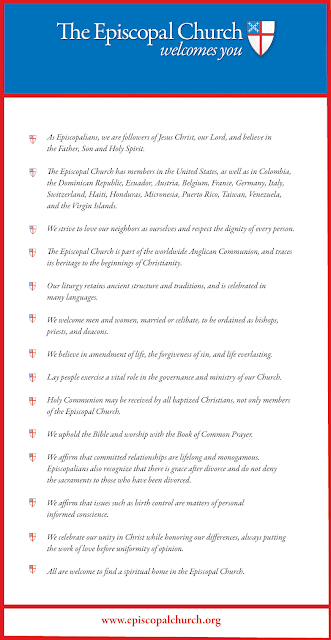
Some have criticized the ad for being too wordy, for trying to say too many things, or for not being visual enough. I, however, did not mind it. It seems to me that this ad uses brief summaries of our doctrines and policies precisely because those issues have been stake in recent well-publicized controversies.
I would have phrased a couple of the statements differently, but I didn't write it. The ad tries to proclaim both our Christian orthodoxy and our inclusive spirit, and I appreciate that.
(click on it to see it more clearly and legibly)

Some have criticized the ad for being too wordy, for trying to say too many things, or for not being visual enough. I, however, did not mind it. It seems to me that this ad uses brief summaries of our doctrines and policies precisely because those issues have been stake in recent well-publicized controversies.
I would have phrased a couple of the statements differently, but I didn't write it. The ad tries to proclaim both our Christian orthodoxy and our inclusive spirit, and I appreciate that.
03 November 2009
RING THE BELLS THAT STILL CAN RING: BLESSINGS AND ANGLES
If we have the ears for it, blessing comes from all sorts of angles in this world; and what amazing blessings these last two weeks have brought to me. The blessings began when I was honored to accompany good friends to the latest Leonard Cohen concert in Atlanta. I realize he is too somber (and worse!) for some people. But, strangely, I have always found Leonard Cohen’s deep and dark poems to have a wonderfully uplifting spiritual effect. He was born Jewish, in Canada, and his spiritual explorations (including holy time in a Buddhist monastery) have blessed me.
He is the one who always sings “there's a blaze of light in every word; it doesn't matter which you heard - the holy or the broken Hallelujah.” Some of us have been following him ever since he sang “Suzanne,” right on through “Bird on a Wire,” “The Sacrifice of Isaac” (now there is an accurate interpretation of Genesis 22), to the modern “First We Take Manhattan,” and “A Thousand Kisses Deep.”
I commend Leonard Cohen to everyone, though I know only some will hear the blessing of his words. His concert was more like a holy recital for me; he began over half of his songs literally on his knees, as if he were coaxing the spirit from instruments and voices. He always left the stage literally skipping, dancing with the energy of a whimsical seventy-five year old man.
The words of Leonard Cohen that I have most often quoted in sermons and presentations are from his song, “Anthem,” and they bear repetition: “Ring the bells that still can ring, forget your perfect offering. There is a crack in everything. That’s how the light gets in.” (If I am feeling feisty, I will juxtapose those words with those from the song, “Jazz Police,” which start like this: “Can you tell me why the bells are ringing? Nothing’s happened in a million years.”)
Leonard Cohen blessed me. A week later, Richard Rohr blessed me. I know that for several weeks, we have heard reactions to the news that the Roman Catholic Church will announce a process whereby certain Anglicans can join the Roman Church as a group. The world still does not know strict details about this process, but that absence did not keep many from speaking irresponsibly about “takeovers” and “sheep-stealing.”
Meanwhile, however, at the Cathedral of St. Philip, we were busy being blessed by the ministry of one of the great contemporary writers on contemplative spirituality, Father Richard Rohr. Yes, he is a priest. Yes, he is actually Roman Catholic, ordained as a priest in the Franciscan order.
He spoke on delightful issues, such as his claim that Jesus of Nazareth was the first non-dualistic thinker in Western Civilization. He reminded us that true contemplative spirituality is really just another phrase for “prayer,” and that true prayer is about observing the world non-dualistically. (His recent book, The Naked Now, has a special section about how important the little word “and” is.)
Over five hundred members and friends of the Cathedral heard Richard Rohr on a Saturday. What a great day it was (even with competition for parking places with the Cathedral Farmers Market)! Richard Rohr came to the Cathedral of St. Philip not in order to take sides, or even to represent a certain faithful Christian denomination. He came to share his life and experience of the holy. It just so happened that he spoke while many other pundits were trying to pit the Roman Catholic and the Anglican churches against one another! On Sunday morning, he delivered the final blessing at our Episcopal eucharist. I was truly blessed.
Then came All Saints Day at the Cathedral of St. Philip. We were blessed to read the names of saints during the Sunday afternoon Requiem Eucharist. We remembered holy people with holy names, all in the setting of Gabriel Faure’s moving Requiem Mass. We were blessed, and God was blessed.
That was our first Requiem Eucharist. The day afterwards, Monday, we held our twenty-first annual Requiem Eucharist and Dinner for the Homeless. Each year, using buses, the homeless from all over Atlanta are our guests for dinner. Then, at the huge evening Eucharist, we read the individual names of the homeless men, women, and children who have died in the past year on the streets of Atlanta. We ring the Cathedral bell at each name; each name was a gift of God to this world. We always have a guest preacher; and, this year, we were blessed by the Reverend Dr. Joseph Lowery.
In the same way we welcomed Father Richard Rohr, I was proud to welcome the Reverend Dr. Joseph Lowery. Naturally, he was proud of having spoken at the inauguration of President Barack Obama. But his deeper words reminded us of an image from Dr. Martin Luther King, Jr., that “there is no separate path to black fulfillment and power that does not intersect with white paths, and there is no separate white path to power and fulfillment that does not share that power with black aspirations.”
For Dr. Lowery, that means that, no matter who we are, all our lines intersect. For me, however, that means our lives are always forming angles of blessing with other lives. All our intersecting lines form blessing. Some of those angles of blessing are Jewish, and some are Roman Catholic, and some are Anglican. Some of those angles might not be considered religious at all. Some of those angles are black, and some are white.
This season of All Saints has reminded me again of the various lines of light that have shined on my life. There is no perfect religion, no pure denomination that we can convert to, nor even any perfect saint, who always gets it right. There is always another angle of blessing, and God uses every one of us, no matter what our condition. “Ring the bells that still can ring. Forget your perfect offering. There is a crack in everything. That’s how the light gets in.”
He is the one who always sings “there's a blaze of light in every word; it doesn't matter which you heard - the holy or the broken Hallelujah.” Some of us have been following him ever since he sang “Suzanne,” right on through “Bird on a Wire,” “The Sacrifice of Isaac” (now there is an accurate interpretation of Genesis 22), to the modern “First We Take Manhattan,” and “A Thousand Kisses Deep.”
I commend Leonard Cohen to everyone, though I know only some will hear the blessing of his words. His concert was more like a holy recital for me; he began over half of his songs literally on his knees, as if he were coaxing the spirit from instruments and voices. He always left the stage literally skipping, dancing with the energy of a whimsical seventy-five year old man.
The words of Leonard Cohen that I have most often quoted in sermons and presentations are from his song, “Anthem,” and they bear repetition: “Ring the bells that still can ring, forget your perfect offering. There is a crack in everything. That’s how the light gets in.” (If I am feeling feisty, I will juxtapose those words with those from the song, “Jazz Police,” which start like this: “Can you tell me why the bells are ringing? Nothing’s happened in a million years.”)
Leonard Cohen blessed me. A week later, Richard Rohr blessed me. I know that for several weeks, we have heard reactions to the news that the Roman Catholic Church will announce a process whereby certain Anglicans can join the Roman Church as a group. The world still does not know strict details about this process, but that absence did not keep many from speaking irresponsibly about “takeovers” and “sheep-stealing.”
Meanwhile, however, at the Cathedral of St. Philip, we were busy being blessed by the ministry of one of the great contemporary writers on contemplative spirituality, Father Richard Rohr. Yes, he is a priest. Yes, he is actually Roman Catholic, ordained as a priest in the Franciscan order.
He spoke on delightful issues, such as his claim that Jesus of Nazareth was the first non-dualistic thinker in Western Civilization. He reminded us that true contemplative spirituality is really just another phrase for “prayer,” and that true prayer is about observing the world non-dualistically. (His recent book, The Naked Now, has a special section about how important the little word “and” is.)
Over five hundred members and friends of the Cathedral heard Richard Rohr on a Saturday. What a great day it was (even with competition for parking places with the Cathedral Farmers Market)! Richard Rohr came to the Cathedral of St. Philip not in order to take sides, or even to represent a certain faithful Christian denomination. He came to share his life and experience of the holy. It just so happened that he spoke while many other pundits were trying to pit the Roman Catholic and the Anglican churches against one another! On Sunday morning, he delivered the final blessing at our Episcopal eucharist. I was truly blessed.
Then came All Saints Day at the Cathedral of St. Philip. We were blessed to read the names of saints during the Sunday afternoon Requiem Eucharist. We remembered holy people with holy names, all in the setting of Gabriel Faure’s moving Requiem Mass. We were blessed, and God was blessed.
That was our first Requiem Eucharist. The day afterwards, Monday, we held our twenty-first annual Requiem Eucharist and Dinner for the Homeless. Each year, using buses, the homeless from all over Atlanta are our guests for dinner. Then, at the huge evening Eucharist, we read the individual names of the homeless men, women, and children who have died in the past year on the streets of Atlanta. We ring the Cathedral bell at each name; each name was a gift of God to this world. We always have a guest preacher; and, this year, we were blessed by the Reverend Dr. Joseph Lowery.
In the same way we welcomed Father Richard Rohr, I was proud to welcome the Reverend Dr. Joseph Lowery. Naturally, he was proud of having spoken at the inauguration of President Barack Obama. But his deeper words reminded us of an image from Dr. Martin Luther King, Jr., that “there is no separate path to black fulfillment and power that does not intersect with white paths, and there is no separate white path to power and fulfillment that does not share that power with black aspirations.”
For Dr. Lowery, that means that, no matter who we are, all our lines intersect. For me, however, that means our lives are always forming angles of blessing with other lives. All our intersecting lines form blessing. Some of those angles of blessing are Jewish, and some are Roman Catholic, and some are Anglican. Some of those angles might not be considered religious at all. Some of those angles are black, and some are white.
This season of All Saints has reminded me again of the various lines of light that have shined on my life. There is no perfect religion, no pure denomination that we can convert to, nor even any perfect saint, who always gets it right. There is always another angle of blessing, and God uses every one of us, no matter what our condition. “Ring the bells that still can ring. Forget your perfect offering. There is a crack in everything. That’s how the light gets in.”
Subscribe to:
Posts (Atom)